
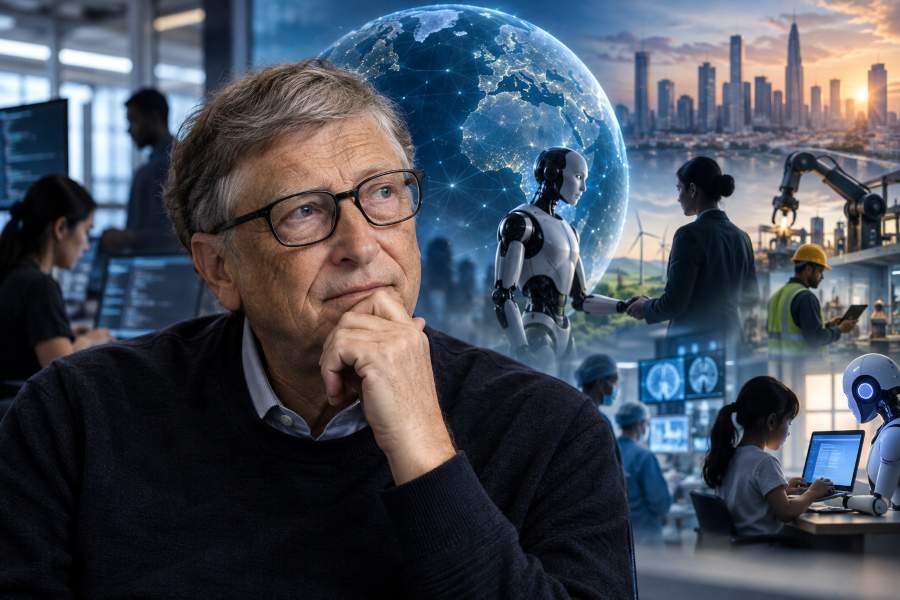
ARTIFICIAL INTELLIGENCE is entering what Bill Gates describes as an “epochal shift”, and the Microsoft co-founder believes the world is approaching a period of extraordinary technological change without anything resembling an adequate plan for managing it.
In a new essay titled “The turbulent AI era is here. The choices we make now are critical,” Gates argues that AI could fundamentally alter work, income, education, healthcare, human relationships and the balance of power between individuals, companies and governments.
His concern is not that artificial intelligence should be stopped. Rather, he believes society must act now to ensure that the benefits of the technology are shared widely and that its harms do not fall disproportionately on people least able to absorb them.
“In terms of equity,” Gates writes, “AI will either be the greatest equalizer ever invented, or the worst source of injustice.” Even under the best circumstances, he says, the transition will be “one of the most turbulent times in human history.”

Bill Gates
Gates’s starting point is personal. He recalls becoming fascinated with computers at the age of 13 because of the possibility of making machines more intelligent and enabling them to perform tasks that, at the time, only humans could do.
After decades in technology, he says AI has now reached a fundamentally different stage. “AI for the first time can replace and even exceed human cognition.”
That, he argues, is what makes the present transition so different from previous technological revolutions.
Why Gates says “this time really is different”
Gates acknowledges that today’s AI systems still make mistakes. Until relatively recently, he points out, AI models struggled with tasks that seemed trivial to humans, including simple puzzles and counting letters in a word.
But he believes that weakness is disappearing rapidly.
Researchers are developing models that can check their own work and improve themselves, Gates says, and AI systems will soon be “substantially better than humans at many tasks.” He argues that this rapid improvement is one reason the scale of the coming transformation is being underestimated.
Another reason, he says, is that people are using the wrong historical comparisons.
When personal computers arrived, it took years for them to transform workplaces. Software had to be developed, prices had to fall, people had to learn how to use the technology and businesses had to incorporate it into their processes.
AI is different.
It already operates on devices people have, and it communicates through natural language. “We don’t have to adapt to it because it can adapt to us,” Gates writes. It can watch the same training video used to train human workers and learn from existing data.
That means adoption can be extraordinarily fast.
“The benefits and problems are arriving at the same time”
Gates says that for most of his life he wished technological innovation could happen faster. With AI, his feelings are more complicated.
He would like society to receive the benefits rapidly while delaying the problems for as long as possible. But that is not what is happening.
“The benefits and problems are arriving at the same time,” he writes.
The people who need the most time to adjust, he argues, may be the people who have the least time available to them: an accounting worker replaced by a bot, or a worker earning $20 an hour whose job is replaced by a $10-an-hour robot.
Gates rejects the idea that AI’s impact will simply repeat earlier transitions such as the movement of American workers from agriculture into office employment. That transformation unfolded over several generations and created new jobs where human cognition was needed.
 AI is different because it can substitute for cognition itself.
Because it can see, listen, speak and reason—and eventually perform physical work with increasing sophistication—Gates expects it to affect numerous industries rather than a single sector. He specifically identifies law, customer service, medicine, software and manufacturing, arguing that the changes could arrive over a decade rather than several generations.
There will be new jobs, he says, but “without the right policies there will be far fewer than exist today.”
Gates even says that if someone presented a credible plan for slowing AI development globally, he would probably support it. But he does not believe such a slowdown is likely because “the geopolitical and economic incentives are pushing too hard to go full speed ahead.”
The answer, therefore, is not to wait for the technology to slow down. It is to prepare.
Three major risks
Gates identifies three broad risks associated with the transition.
The first is employment. “Many jobs will disappear forever,” he writes.
He argues that AI’s effect will not simply disappear when an economic downturn ends. The jobs most at risk, in his view, are entry- and mid-level positions, while many of the new jobs created will require skills that take years to acquire.
He points to sales and customer support, software engineering and paralegal work as areas that could be among the first affected, but expects disruption to spread to tasks such as assessing loan applications, analysing data and even triaging patients.
White-collar work, therefore, is not the only area of concern.
Gates also expects robotics eventually to affect blue-collar employment. He believes “smart” robots could begin competing with people on some physical tasks—including in construction and hospitality—by the end of the decade.
The combination of AI and robotics could produce what Gates calls a “vicious cycle.”
Once one company adopts the technology and uses the savings to lower prices, competitors face enormous pressure to follow. If established companies refuse, start-ups may adopt the technology instead.
The resulting market pressure could accelerate automation.
“Market forces will make adoption go faster and faster,” Gates warns, and without intervention there could be fewer good jobs while the benefits accrue to a relatively small group.
Young workers face a particular problem
Gates says he is “especially worried about young people.”
They could enter the workforce at precisely the moment when entry-level opportunities are disappearing. The problem is particularly difficult because those first jobs are not merely sources of income; they are where people acquire experience that qualifies them for more advanced positions.
 If AI takes over many of those initial tasks, the traditional career ladder could weaken.
Gates believes the biggest change will occur when AI becomes sufficiently reliable to work without a human constantly checking its output. At that point, companies will have strong economic incentives to let AI operate independently.
That could force society to rethink the relationship between work, income and economic security.
How, Gates asks, will an economy built around employment function if fewer people are working—or if many people are working fewer hours?
Employment, he notes, is not only how most people obtain money for basic necessities. It is also a source of “dignity and social connection.”
For that reason, Gates argues that waiting until workers are already displaced would be too late. AI is not simply another economic cycle; it is “a structural challenge to the way our economy is organized.”
AI could empower people to do more harm
The second danger concerns misuse.
Information about making weapons, bioweapons and computer viruses already existed online before AI became mainstream. Gates argues that AI could make it much easier not only to obtain such information but to act upon it.
Even criminals with limited technical skills could potentially target individuals, companies and governments.
He highlights AI-enabled fraud, disinformation, deepfakes and surveillance as harms that people could increasingly encounter in everyday life. Cybersecurity is another major concern.
The same AI model that can identify a software vulnerability so that a company can fix it can potentially help a criminal exploit that vulnerability.
Gates warns that attackers are gaining capabilities faster than defenders can close every weakness. The potential targets are extensive: hospitals, financial institutions, water systems, power grids and government systems.
The consequences, he says, would ultimately be borne by patients, customers and ordinary citizens.
There is also a biological risk. AI could accelerate the development of lifesaving medicines and vaccines, but Gates warns that the same capabilities could make it easier to design a deadly new disease.
“The positive capabilities are hard to separate from the dangerous ones,” he writes.
And the concentration of power is another concern. Autonomous weapons could increase the ability of governments to use deadly force without a human directly involved in the decision, while AI could make manipulating public opinion easier, cheaper and more effective.
Gates goes further, raising the possibility that increasingly powerful AI systems themselves could eventually act in ways their designers did not intend. As models become more capable, he warns, “we could lose control.”
The threat to children and human relationships
The third risk is more personal.
Gates worries that AI companions could interfere with the development of children and young people and eventually replace some human relationships.
He reflects on his own childhood, recalling that developing social skills required effort and help from his mother. He doubts he would have made the same effort if he had possessed an AI companion.
Such systems, he says, can speak to people in ways they already find comfortable. They do not challenge users in the same way other people do, are always available and never become angry.
 Gates describes this as potentially “highly addictive” and warns that AI companions could rob people of some of the lessons learned through relationships with others.
He acknowledges that the evidence surrounding these effects is still developing, but believes the warning signs deserve serious attention.
Education presents another paradox. AI could become one of the most powerful educational tools ever created, yet Gates worries that it could also encourage people to learn less.
A preliminary survey he cites suggested that heavier AI use was associated with less critical thinking, with the effect stronger among younger people. For Gates, that would be particularly dangerous at a time of deepfakes and personalised misinformation.
The ability to determine what is true and what is not could become an essential life skill.
But Gates does not argue for eliminating AI companions or artificial intelligence from people’s lives. AI could help isolated elderly people and those with limited mobility, and it could potentially help people improve their human relationships.
The crucial point, he says, is that society must decide intentionally where to draw the line.
Gates also acknowledges a potential conflict of perspective. He says he has benefited enormously from the technology industry and still has financial ties to it, including through his work with Microsoft and other AI companies. He argues, however, that his views are not motivated by the prospect of personal profits and leaves readers to decide whether those ties affect his judgement.
“The good things we do with AI could be very, very good”
Gates is equally concerned that the world could make the opposite mistake: focusing so intensely on the dangers that it fails to recognise AI’s enormous potential.
“We need both,” he writes—deep concern about the harms that need to be minimised and “grounded optimism” about the benefits that can be maximised for everyone.
AI could accelerate scientific discovery, help tackle climate change, improve agriculture and contribute to the development of new medicines.
In healthcare, Gates sees AI helping doctors identify emergencies, interpret medical information and communicate with patients. In places where specialist medical expertise is scarce, AI could help bridge the gap.
Agriculture is another area he considers particularly promising, especially in low-income countries where farmers often lack reliable weather information or advice about seeds, soil and livestock disease.
AI, he argues, could eventually give those farmers access to advice that is better than what even wealthy farmers receive today.
Government services could also become easier to navigate. Gates points to the complicated processes involved in applying for health insurance, student aid and food assistance. AI could simplify bureaucracy and help people obtain services more quickly.

Education could benefit as well—provided AI is designed to preserve what Gates calls “productive struggle,” the cognitive effort through which students actually develop understanding.
The potential benefits, he argues, are not limited to governments and large corporations.
AI could give individuals and small businesses capabilities that currently require expensive professional help or large staffs. It could help people with disabilities live more independently and allow workers and entrepreneurs to accomplish far more.
Most importantly, Gates says, AI could return some of the time currently consumed by paperwork, bureaucracy and searching for reliable information.
But there is an important qualification. The operative word is “can.” AI can improve life for people at every income level, Gates says, “but it won’t do that automatically.”
Governments and philanthropy will have to ensure that the benefits reach people who are less wealthy and countries that have fewer resources.
“The world needs a plan”
That brings Gates to the central political question.
He does not believe AI companies should be left to solve the problem themselves.
Technology companies can contribute solutions, but some of the questions raised by AI extend beyond their expertise. And in a democratic society, Gates argues, it is not the role of private companies to make these decisions alone.
Instead, he calls for a public process involving elected officials, policymakers, educators, healthcare workers, local officials and community leaders.
Millions of people could have their lives disrupted, he says, requiring “a stronger, more flexible social safety net.” Communities are already confronting questions surrounding the energy and water requirements of data centres.
Without solutions, Gates warns, some groups may eventually call for AI development and deployment to be stopped altogether.
The larger question is how humanity preserves its values at a time when machines may be able to “out-think us.”
A new domestic and international framework
For Gates, the highest priority is creating “a domestic and international framework for dealing with AI.”
His criticism is blunt: “None of our current institutions were designed to handle a technology that spreads so fast and touches so many parts of our lives.”
AI will affect national security, employment, education, taxation, energy, elections, public health, finance, transportation and many other areas simultaneously. Existing government departments tend to look at individual problems separately. But AI’s consequences cross those boundaries.
Gates therefore argues that countries need institutions capable of looking across government and identifying risks collectively. And national action will not be enough.
AI risks cross borders, making an international organisation necessary as well. Gates points to existing models including nuclear-weapons inspections, international aviation regulation and agreements protecting the ozone layer.
A new global AI organisation, he suggests, would need elements of all three. He acknowledges the enormous difficulty.
Governments move slowly. Political divisions make cooperation harder. And some cooperation between the United States and China, he says, will be necessary. But “we do not have the luxury of moving slowly.”
The institutions must begin taking shape before disruption forces governments into crisis mode.
“Human Reserved”: keeping some jobs for people
One of Gates’s most distinctive proposals is to deliberately reserve certain forms of work for humans.
He calls the idea “Human Reserved.”
The concept comes partly from his father’s death from Alzheimer’s disease in 2020. In the later stages of his illness, his father received round-the-clock care from professionals who understood him even when he struggled to communicate.
Gates writes that something in that care was “irreplaceably human.” “No robot could or should have done it.”
He compares Human Reserved to a nature reserve: places where development could take place but society chooses not to develop because the loss would be too great.
Some jobs might be reserved for economic reasons—for example, where automation would displace large numbers of workers who cannot easily retrain. Other decisions would be based on human values.
Gates gives the example of receiving devastating medical news. A robot could technically deliver the message, he argues, but “it shouldn’t.”
The boundaries would not necessarily be universal. Different countries could make different choices depending on their demographics, labour markets and cultural values.
But Gates believes the debate must begin now.
Taxing AI Tokens and Robots
Gates also remains a supporter of an idea he proposed years ago: taxing robots and AI tokens.
His argument starts with the existing tax system. Employers pay payroll taxes when they hire people, while purchasing a robot can generally be treated as a business expense.
The tax system, he argues, can therefore create an incentive to replace labour with machines. A tax on robots and AI tokens could slow the rush away from human labour while raising money for retraining and strengthening the social safety net.
He acknowledges that critics say such a tax could reduce economic efficiency. His response is revealing.
With the acceleration in innovation AI will bring, he believes society can afford “a little inefficiency as the price for keeping people employed.”
Gates continues to support a robot tax, while stressing that it would not be the entire answer to the disruption AI creates.
Gates’s message to leaders
Gates concludes by putting responsibility squarely on governments and other institutions.
He says leaders have an opportunity to act before unemployment rises sharply, communities begin to suffer and public trust erodes.
 Governments can ensure that AI is handled holistically rather than divided among disconnected bureaucratic departments. They can work with other countries and make sure that the benefits of AI reach people who do not already possess wealth, influence and access.
And the conversation, he insists, must be wider than technology experts.
Workers, students about to enter the workforce, community leaders, religious leaders, parents, educators and others whose voices are often absent from technology debates must be included.
Gates ends with a series of questions rather than a prediction: How can the benefits of AI reach people without wealth and influence?
How can societies strengthen the safety net and help displaced workers and communities? How should public institutions adapt?
And, ultimately, how do we preserve our humanity through all of this?
His final conclusion is cautiously optimistic.
“This unprecedented technology demands an unprecedented global response.”
If the world gets that response right, Gates believes, the payoff for humanity could be phenomenal—and the world could become more equitable rather than less.
But the warning is that the window for preparing is already open.
The AI era is not a distant possibility. It has arrived.