
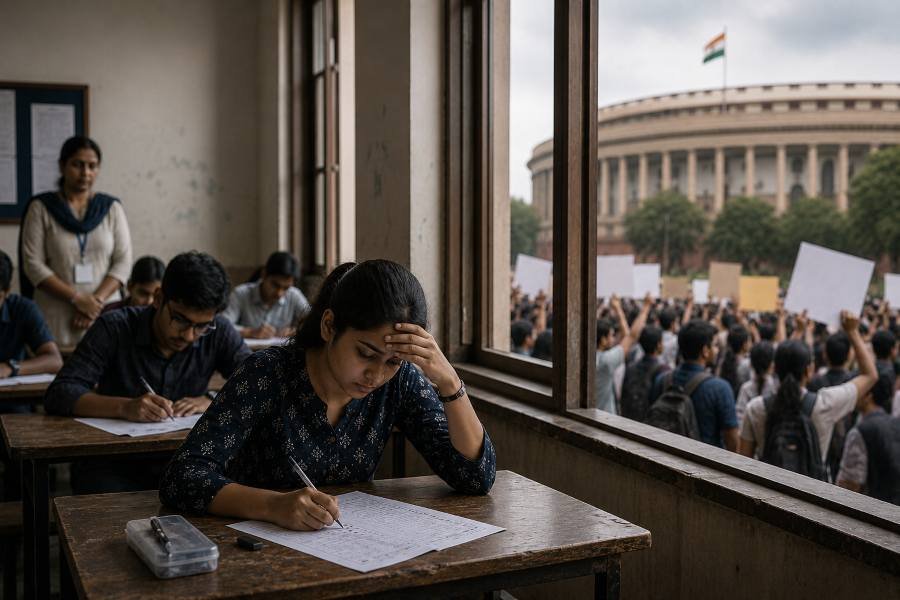
THE MUCH-AWAITED resignation of Union Education Minister Dharmendra Pradhan has led the agitating students to call off their protest. However, the government cannot afford to rest on its oars and must now focus on the education sector, which has largely remained neglected.

This lack of priority is reflected in the financial allocations made to the Education Ministry, earlier known as the Ministry of Human Resource Development, in the Union Budget. Data compiled by the Economic Outlook Module of the Centre for Monitoring Indian Economy (CMIE) reveals the low priority accorded to the education sector during the last decade.
The data does not take into account the actual amount allocated, which naturally increases every year because of inflation and the overall rise in government expenditure. Instead, it focuses on the percentage share of funds allocated to different ministries.
The data clearly shows that the share of the Education Ministry (erstwhile Ministry of Human Resource Development) has fallen sharply from the budget allocations during the UPA regime to those under the current dispensation.
Its share in the Union Budget declined from 4.6 per cent in 2013-14, the last budget presented by the UPA government, to a mere 2.5 per cent in 2025-26. Thus, the ministry’s share has dwindled to almost half of what it commanded under the previous government.
Shrinking Budget, Growing Challenges
The ministry receives allocations for two departments: School Education and Higher Education. The data shows that the share of the Department of School Education is now less than half of what it was a dozen years ago, while the share of the Department of Higher Education is now only about 60 per cent of its earlier level.
 Significantly, in sharp contrast, allocations for the construction of roads and highways have increased threefold over the last 12 years.
Even the much-touted scheme for providing skills to the youth has foundered. A separate Ministry of Skill Development was created in 2015-16. It was indeed a good initiative, but its share of the Union Budget was only 0.06 per cent in its inaugural year and has since declined further to 0.05 per cent.
Even the choice of ministers to head the Education Ministry reflects the low priority accorded by the government. The first Education Minister under the NDA was Smriti Irani, whose own educational qualifications were widely questioned. Even Dharmendra Pradhan was hardly seen as being well suited to head such an important ministry.
States Also Share Responsibility
Since education falls under the Concurrent List, both the Central and state governments are responsible for policymaking. The average allocation by all states taken together has also declined from 14 per cent in 2008-09 to 13 per cent in 2025-26.
Although the decline is not as sharp as that at the Centre, several states have also lagged behind.
A look at the Gross Enrolment Ratio (GER), which measures the total number of students enrolled as a proportion of the population in the relevant age group, also highlights disparities among states. For instance, Bihar has a GER of just 45 compared to Kerala’s 94.
Beyond Exam Reforms
Thus, on the one hand, there has been a decline in resources allocated to the education sector and, on the other, the persistence of a flawed examination system. What triggered the latest student unrest was the leakage of the NEET question paper, but there have been about 150 instances of question paper leaks involving competitive examinations during the last decade.
 An investigation into 45 major exam leaks by The Indian Express revealed that proceedings in only two of these cases had resulted in convictions, while the rest remain stalled in legal proceedings.
Education, particularly primary education, must be at the centre of the government’s priorities if India is to emerge as a strong nation and a robust economy. Unfortunately, it has remained one of the most neglected sectors. Education should attract the country’s best talent, but low wages and poor working conditions discourage capable people from entering the profession.
The recent student agitation must become the catalyst for large-scale reforms in the education sector and should not be confined to setting up yet another committee to reform the examination system