
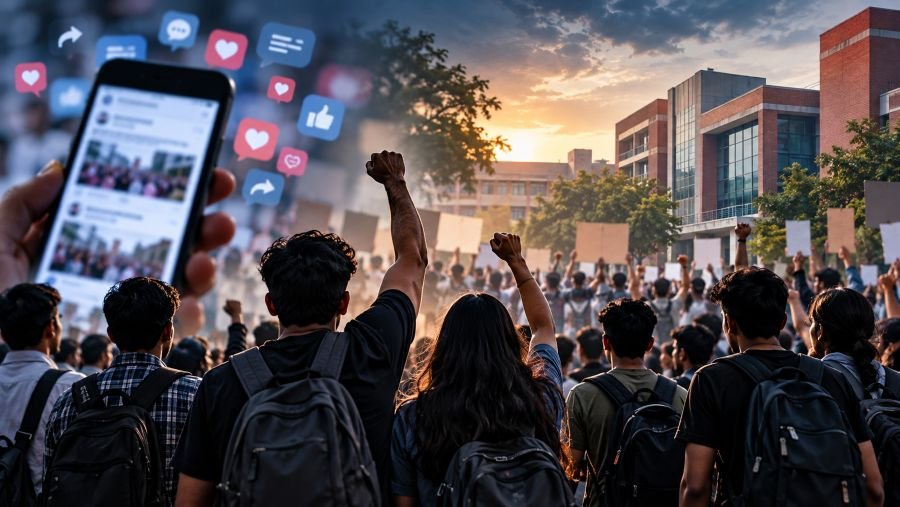
PUNJAB WITNESSED TWO back-to-back incidents, both based on rumours and unverified reports, leading to unrest among students of two private universities in the state.
The protests followed rumours about the alleged suicide of two female students at one of the universities, while allegations of rape of a hostel resident led to protests and violence at the other university.
Significantly, the alleged victims in both instances remain unidentified, and there is not even an iota of evidence that any such incidents ever took place.

Another important aspect of the two protests is that these were leaderless and the protesters were highly emotionally charged. Fuelled by social media posts, which spread the rumours like wildfire, they were apparently convinced that the incidents had actually taken place.
The recent protest at Jantar Mantar was also largely leaderless, as students and youth from across the country joined the protest in the national capital, leading to the resignation of Union Education Minister Dharmendra Pradhan.
Protests had also erupted across several cities like Patna, Ranchi, Pune and Jaipur, and at all these places the protests were spontaneous and leaderless.
Incidentally, similar leaderless protests were witnessed in recent months in Sri Lanka, Bangladesh and Nepal, leading to the overthrow of governments in those countries.
The Union Home Ministry is reported to have set up a committee to examine the causes of mass protests and suggest ways to tackle such situations. It is not known whether any report has been submitted to the government as yet.
Growing Unrest Among Students and Youth
However, growing unrest among students and youth is a stark reality in the country. It has manifested itself in the recent protests and is directly correlated with increasing frustration driven by a mix of economic, institutional, social and cultural factors.
The most evident and genuine cause of the simmering discontent among youth is the lack of adequate employment opportunities.
 India adds about 12 million youth to the working-age population annually, but comparatively fewer jobs are available. Vast numbers of graduating students have to settle for either underemployment or contract jobs with no job security and limited upward mobility.
Degrees are apparently not aligning with industry needs. The graduates being churned out by thousands of colleges and universities do not have the required skills and face an uncertain future.
Adding fuel to the fire are frequent reports about the leakage of question papers for competitive examinations and allegations of corruption and nepotism in recruitment, admissions and local governance.
All this comes despite the high cost of education, particularly in private institutions. The additional burden of coaching further adds to the financial pressure on families.
The Missing Channels of Communication
The pattern of protests in the recent past clearly shows a lack of formal channels for redressal of grievances and an absence of communication between students and the authorities. The simmering resentment then breaks out in the form of impromptu protests, often leading to violence triggered by unruly elements.

Although most institutions claim they have platforms where students can express their concerns, or where mental and career-related counselling is provided, such platforms remain largely neglected.
There is also an urgent need for all institutions to take care of the mental health of students and to have counsellors. According to the latest National Crime Bureau report, 14,488 students committed suicide in 2014, and the trend shows a rising number of suicides and suicide attempts in the country.
All stakeholders, including the government, educational institutions, social scientists and experts, must work together to address the issues impacting the youth and find ways to channelise their energy.