
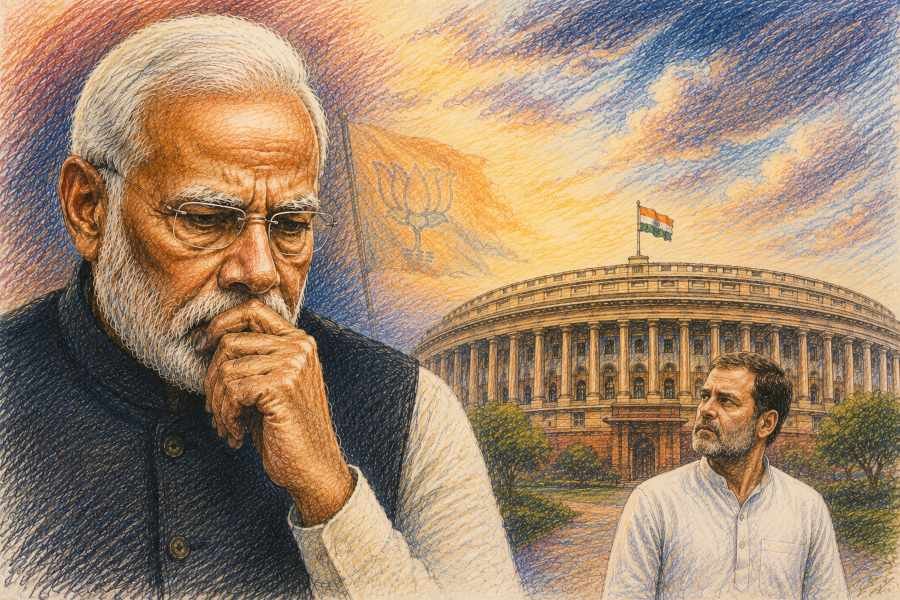
HAROLD WILSON, the British Prime Minister in the 1960s, once said that a week is a long time in politics. The sudden loss of popular support for the BJP government and the declining clout of Prime Minister Narendra Modi show how correct the British statesman was.
It is difficult to believe that the BJP, which scored a resounding victory in the Assembly elections less than 100 days ago, is now on the defensive, with its once-boisterous leaders apparently shying away from facing the Opposition in Parliament and on public platforms.
All seemed to be going well for Modi and the party. The BJP was confidently looking towards the next round of Assembly elections early next year in five states, including the all-important Uttar Pradesh. There was even talk that victory in these elections would pave the way for Modi’s return to power in the 2029 Lok Sabha elections.
Then, suddenly, the political atmosphere changed dramatically, and questions are now being raised about Modi’s ability to continue in office until the end of the present term.
How Did the BJP’s Political Momentum Shift So Quickly?
What happened so suddenly to bring about such a paradigm shift in the political scenario is certainly a matter of surprise.
It is difficult to believe that a two-month-old Cockroach Janata Party (CJP), an assemblage of students and unemployed youth with relatively unknown leadership, could so severely shake the foundations of a government that has enjoyed an unchallenged position in the country for more than a decade.
What is not being appreciated, however, is that the CJP and its leadership merely provided an outlet for simmering discontent to emerge in the form of a massive protest movement. There were unmistakable signs of growing frustration among several sections of society over the arbitrary ways of the Modi government.
 The only problem was that this discontent had not found an effective means of expression.
It can be argued that, because of a myopic worldview and arrogance, the overconfident BJP leadership either failed to see this simmering discontent or dismissed it as being of little consequence. The result is the crisis in which the BJP now finds itself.
For political analysts, the big question is: what has caused this sudden and catastrophic decline in the BJP’s support? If things were deteriorating so rapidly for the ruling establishment, why were there no visible signs of such a steep downslide?
Many factors have contributed to the Modi government’s dwindling support. These include price rise, increasing unemployment, curbing of dissent and aggressive campaigning by the Opposition, led by Rahul Gandhi. The cancellation of the NEET examination in the wake of the question paper leak undoubtedly provided an immediate trigger.
The Media Factor Behind Modi’s Declining Popularity
All these factors are important, but what has not received adequate attention is the role of mass media.
Strategies implemented through print, audio-visual and digital media play a crucial role in making or unmaking the image of a public leader.
 Modi and his much-discussed IT cell did a great deal to distort the image of the Nehru-Gandhi family in general and Rahul Gandhi in particular. They largely succeeded in doing so.
However, they apparently failed to understand some basic principles of mass communication, and this is now proving to be their undoing.
One simple rule of communication is that prolonged and relentless criticism can create sympathy for the person being criticised. People may gradually begin to view that person as a victim being unfairly targeted by the powerful.
Similarly, excessive and sustained praise can also produce a counter-effect. Criticism and praise are best absorbed when they are measured.
How Rahul Gandhi’s Image Changed
It is no blasphemy to say that, unlike some other members of the Nehru-Gandhi family, Rahul Gandhi initially failed to build a bridge with political workers and the masses because of his tone and tenor. That is why the BJP media machinery’s description of him as “Pappu” initially gained currency.
 Combined with the apathy of the entrenched Congress leadership, popularly known as the Group of 23, Rahul Gandhi could not make much of a dent in the country’s political landscape for quite some time.
However, the BJP’s aggressive campaign to run him down and marginalise him, coupled with his resilience, has gradually turned the tables on the BJP leadership.
Had the BJP’s media and image planners left Rahul Gandhi where he was after the Congress’ humiliating defeat in the 2014 elections, perhaps they would not now be facing such a formidable challenge from him at the centre of power.
Similarly, Modi and his image-makers made another blunder by indulging in excessive self-praise and making boisterous claims about what they had achieved and what they proposed to accomplish. Now, when they are being questioned from all sides about the validity of these claims, they have difficulty providing convincing answers.
Can the Modi Government Recover From This Crisis?
The steep decline in Modi and his government’s popular support should therefore surprise no one.
The massive agitation organised by the Cockroach Janata Party and its young leaders has dented Modi’s image. The insensitive handling of the agitation and the repression of young boys and girls have made the situation even worse for the government.
The Prime Minister’s Independence Day speech was apparently an attempt at damage control. But it is unlikely to help much. Their initial training in the neo-fascist RSS ideology appears to have made BJP leaders incapable of fully understanding the democratic temperament.

Modi’s speech, apparently intended to pacify the agitated youth of the country, may prove counterproductive.
The claims made by the Prime Minister are likely to face critical scrutiny and strong rebuttals, point by point. Such counter-attacks may damage the ruling establishment even further.
Perhaps a better strategy for the Modi government would have been to apologise for the alleged police excesses at Jantar Mantar, invite the CJP leaders for talks, listen to their grievances and concede some reasonable demands, such as the withdrawal of cases against the students.
But a power-drunk and arrogant political ecosystem has chosen the opposite course: criminalising young students and dismissing their genuine demands for a better education system.
Having invited confrontation, the ruling establishment must now remain prepared for it. The crucial question is whether the Prime Minister’s Independence Day promises will prove to be the right weapons in its armoury, or whether they will further expose the widening gap between the government and the people.