
Man has two basic attributes: reason and emotion. While the French thinker Voltaire (1694-1778) emphasized reason, the French political philosopher Rousseau (1712-1778) said that overemphasis on reason and the neglect of emotion would result in man becoming cunning, crafty, scheming, totally selfish and calculating, instead of being patriotic and compassionate towards his fellow human beings.

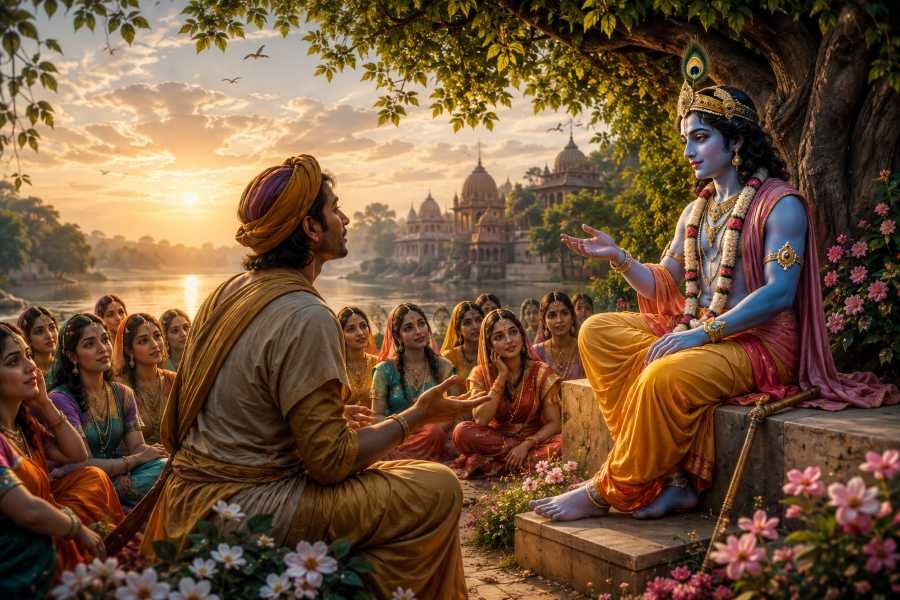
Udho, or Uddhav, was a friend of Lord Krishna. Udho represents reason, while the gopis of Vrindavan, who loved Krishna, represent emotion or passion.
Uddhav was very learned in the Vedas and other shastras, but he did not understand the second attribute of man, namely emotion. He was a gyani, who believed in nirguna brahman and had no understanding of bhakti marg, or devotion to the Lord.
When he was young and an adolescent, Lord Krishna lived in Vrindavan and used to play with the gopis, or girls, there. Later, when he grew up, he shifted to Mathura, where he became the king, but the gopis still pined for him.
Udho’s Message to the Gopis
Udho told Lord Krishna that he should send a message to the gopis of Vrindavan, telling them that they should forget him, since they too had now grown up and would get married and have families of their own.

Their earlier relationship with Krishna was only a teenage infatuation and adolescent flirtation, but it could not continue. They must now behave in a mature manner and forget him.
On hearing this, Lord Krishna smiled, but told Udho to go as his messenger to the gopis.
Accordingly, Udho travelled to Vrindavan and tried to persuade the gopis to forget Krishna. On hearing this, the gopis were shocked.
In the words of the great poet Surdas, they said:
“Udho, man na bhaye das bees
Ek huto so gayo Shyam sang”
That is:
“Udho, we do not have ten or twenty hearts.
We have one, and it has gone with Shyam, or Krishna.”
When Udho kept repeating that they should forget Krishna, the gopis told him that he had gone mad, and they then drove him away.
On returning to Mathura, Udho related to Lord Krishna what had happened. Lord Krishna again smiled and said that he knew what would happen. But since Udho would not listen and was adamant, having great vanity about his learning and thinking that he had great powers of persuasion, he let Udho go to Vrindavan.
Humans Need Both Reason and Emotion
This story shows that human beings do not have reason alone. They have emotions too.
I have mentioned the above story to explain that what is needed in India today is not just reason, that is, rational thinking, but also emotion in the form of patriotism and a passionate desire to help our suffering countrymen and women.
 India faces massive socio-economic problems, including widespread poverty, record and rising unemployment, an appalling level of child malnutrition, skyrocketing prices of essential commodities such as food and fuel, an almost total lack of proper healthcare and good education for the masses, casteism and communalism, among other evils.
Every second child in India is malnourished, according to the Global Hunger Index, and the condition is getting worse, with India slipping from position number 101 to 107 in recent years among the 125 countries surveyed.
Patriotism and a passionate desire to help the country are the crying needs of the hour. But the unfortunate fact is that today’s Indian youth, who should be in the forefront of this struggle, are almost totally selfish and unpatriotic.
After completing their studies, they only want comfortable, well-paid jobs in the civil services or the corporate sector, or to become doctors or engineers, or to go to a Western country and settle there. There is no patriotism or desire in them to serve and uplift India.
Lessons from the American and Indian Freedom Struggles
In the American War of Independence (1775-81), great Americans like George Washington and Thomas Jefferson came forward to lead their country’s fight against British rule, at the risk of their own lives.
These were rich people, and if they had only thought about and cared for themselves and their own families, they would never have fought the British rulers, who would have hanged them if they had been defeated. But it was the spirit of patriotism that made them forget their own comforts and self-interest and fight for their country.
Similarly, in India, great revolutionaries like Bhagat Singh, Surya Sen, or Masterda, Chandrashekhar Azad, Bismil, Ashfaqullah, Sukhdev, Khudiram Bose and others gave their lives fighting against British rule, without a thought for themselves.
One of my heroes is John Brown, who, though a white man, gave his life fighting against the slavery of Blacks in America.
William Lloyd Garrison (1805-1879), the publisher of the journal The Liberator, who strongly advocated the abolition of slavery in America despite great personal danger to himself, wrote:
“Slavery will not be overthrown without excitement, a most tremendous excitement.”

Similarly, poverty, unemployment, hunger and other great socio-economic evils in India will not be overthrown without “tremendous excitement”. This means a massive, historical, united and protracted people’s struggle and a people’s revolution.
Such a struggle must be led by patriotic, selfless and modern-minded leaders determined to establish a political and social order under which there is rapid industrialization, the standard of living of our people steadily rises, and they are able to live decent lives.