
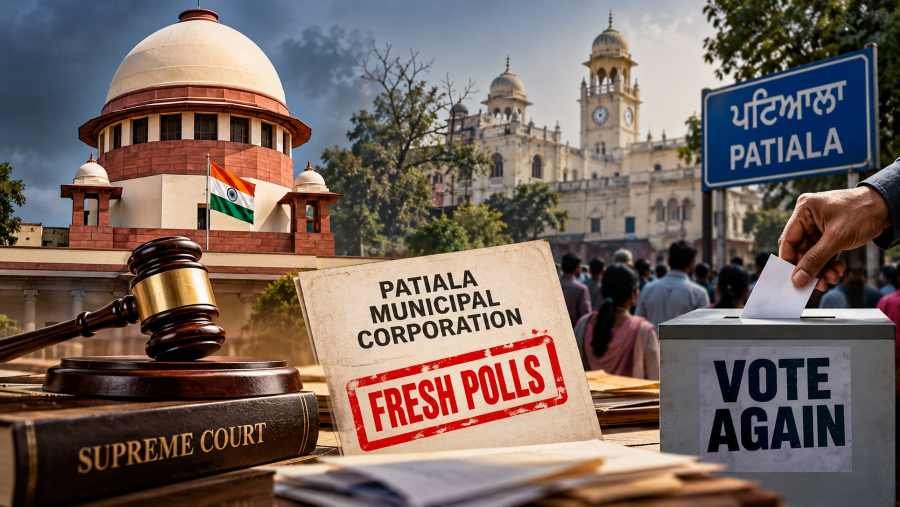
PATIALA IS GOING to vote again. That is the immediate news. But the larger story is about something more fundamental: what makes an election legitimate?
The Supreme Court on September 28 ordered fresh elections in those wards of the Patiala Municipal Corporation where a fact-finding committee appointed by the Court found that violence had marred the electoral process during the December 2024 municipal elections. The Punjab Government agreed to accept the committee’s report.
 The committee, headed by former Punjab and Haryana High Court judge Justice (Retd.) Nirmaljit Kaur, had been appointed by the Supreme Court in March 2025 to examine allegations concerning the December 2024 municipal election process, including claims that candidates had been prevented from filing nominations and that nomination papers had been snatched or torn.
The matter had specifically been listed for September 28. In its September 21 order, the Supreme Court recorded that the connected matters in Seema Sharma & Others v. State of Punjab & Others, SLP(C) No. 3894/2025, were to be taken up on that date.
So Monday’s order was not an unexpected intervention but the latest stage of a judicial process that began with allegations concerning the conduct of the municipal elections and proceeded through a Supreme Court-appointed fact-finding exercise.
When the process becomes the story
Elections are normally reduced to numbers: who won, who lost, which party secured the most councillors and who controls the corporation. But those questions come only after a more basic one has been answered: was the voter allowed to make a free and meaningful choice?
That is what makes the Patiala case unusual. The Supreme Court did not simply accept a political allegation and order another election.
It appointed a fact-finding committee headed by a retired High Court judge; the committee examined the allegations and submitted its report; and the Court has now accepted the report and directed fresh polling in the wards identified by the committee as having been affected by violence.
The distinction matters. A political allegation is one thing; a judicially appointed fact-finding exercise is another. And a Supreme Court direction for a fresh election is a consequence that places the integrity of the electoral process at the centre of the dispute.
The most democratic remedy: go back to the voters
There is something significant about the remedy chosen by the Court. Instead of allowing the dispute to remain an argument over what happened during the original election, the process in the affected wards is being taken back to the ballot box.
 Vote again.
The Court is not choosing the winner, nor is it telling voters which party or candidate deserves their support. It is restoring the opportunity for the electorate to make that decision through a fresh electoral process.
The underlying principle is simple: an electoral mandate derives its legitimacy not merely from the counting of votes, but from the integrity of the process through which those votes were cast.
That is why the Patiala order is bigger than the question of who controls a municipal corporation.
The Bench also accepted a submission that the arrangement should not be treated as a precedent. That qualification is significant.
The fresh polls are a consequence of the particular facts of the Patiala dispute and the findings of the Supreme Court-appointed committee; they do not establish a general rule that a disputed local election must automatically be re-run.
The officials’ question is now separate — and important
There is another significant aspect of Monday’s hearing that should not be lost in the focus on the re-poll.
The Court was told that the fact-finding report contained allegations concerning government officials and that no action had been taken despite the passage of time. Counsel pointed out that two years had passed.
 The Chief Justice responded that the matter had remained pending before the Supreme Court and that, now that the report had been accepted, the authorities would have to act upon it.
The wording matters. The Supreme Court did not, on September 28, pronounce individual officials guilty or prescribe a particular punishment. Rather, it indicated that, with the report now accepted, the competent authorities would have to act upon the matters concerning government officials raised in it.
The question of accountability therefore now moves into its next stage.
A fresh election addresses the question of the electoral mandate. It does not automatically settle the question of institutional responsibility for whatever happened during the earlier process. Those are separate issues and should be dealt with through evidence, due process and the findings of the competent authorities.
Patiala has seen another election controversy
There is also a separate episode involving Patiala’s election machinery that is worth remembering, although it has no evidentiary connection with the Supreme Court’s present municipal-election case.
During the December 2025 Zila Parishad and Panchayat Samiti elections, an alleged conference-call recording involving Patiala police officials became the subject of a political and judicial controversy. The recording was alleged to contain directions to obstruct Opposition candidates during the nomination process.
 The Punjab Police disputed its authenticity, describing it as fabricated and alleging that it was AI-generated. The Punjab and Haryana High Court subsequently took the recording and its transcript on record and directed that the electronic material be subjected to forensic examination.
The controversy did not end there. In February 2026, the High Court directed the Punjab State Election Commission to have the audio examined by an independent agency outside the control of the State, amid concerns over the manner in which the electronic material had been handled.
That episode concerns the later rural local-body elections, not the 2024 Patiala Municipal Corporation election now before the Supreme Court. The two matters must therefore not be conflated.
But taken simply as background, the episode does underline a broader question about public confidence in the conduct of local elections: when allegations concern not merely candidates or political parties but the conduct of the machinery responsible for administering an election, institutional credibility itself becomes part of the story.
An election result is not just a number
The Patiala development also deserves attention as political calculations begin to take shape ahead of the 2027 Assembly election.
There is always a temptation to treat local election results as political opinion polls. A party wins municipal wards and its statewide strength is declared; another party performs poorly and its decline is pronounced.
But municipal elections are different contests, involving different candidates, local issues, alliances, personalities and turnout patterns.

Local election results can certainly provide evidence of organisational capacity and mobilisation. But they should not automatically be converted into a direct measure of statewide Assembly voting intention.
Patiala adds another qualification: before electoral numbers are used as political evidence, the integrity of the process that produced those numbers also matters.
That does not mean that local election results should be dismissed. It means they have to be read in context, particularly when the process itself has subsequently been subjected to judicial scrutiny.
The Patiala case also illustrates why electoral disputes ultimately have to move beyond competing political narratives. Allegations can be accepted, denied or contested in the political arena, but their institutional consequences require an examination of evidence.
In this case, the Supreme Court appointed a fact-finding committee headed by a former High Court judge, considered its report and, after the State agreed to accept it, directed fresh elections in the affected wards.
The significance lies less in which political side claims vindication and more in the fact that the electoral process itself has been subjected to an independent judicially supervised examination.
What comes next
The exact ward-wise scope and timetable should be taken from the detailed Supreme Court order and the subsequent notification of the Punjab State Election Commission.
The September 28 proceedings establish the direction for fresh polls in the wards identified by the committee; the operational details should follow the formal notifications.
 After what has gone before, the second election will inevitably be judged not only by its result but also by the conduct of the process itself. Candidates must be able to contest, voters must be able to choose, the administration and police must be seen to act impartially, and complaints must have credible avenues of redress.
Whatever action is warranted on the committee’s findings concerning officials must likewise follow the appropriate legal and administrative process.
The Supreme Court has not chosen the winner. It has not chosen the party that should control Patiala’s municipal corporation. It has put the choice back where it belongs — with the voters.
Patiala now has a second chance at the ballot box.
And perhaps that is the most important question arising from the entire episode.
Not merely: Who won Patiala?
But: Did Patiala get to choose?