
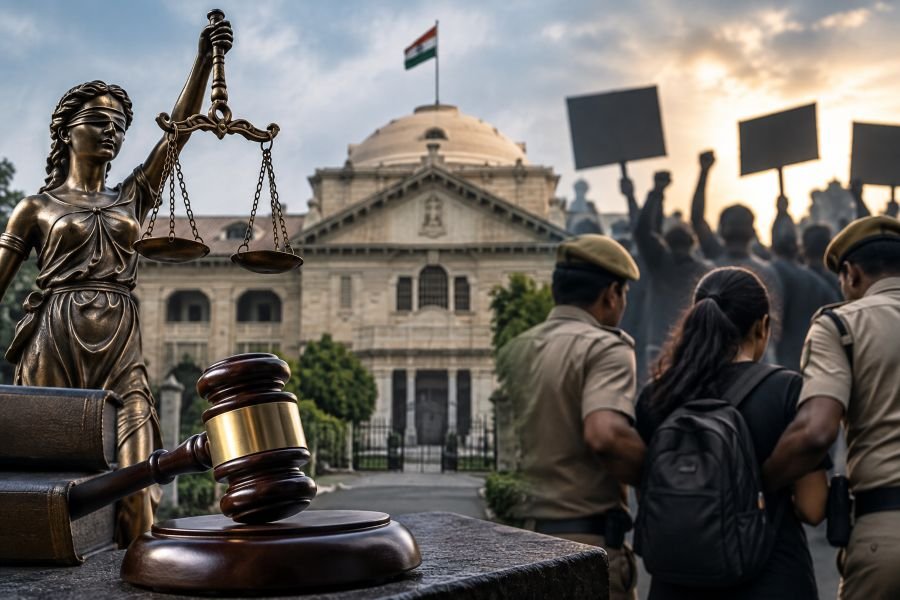
THE JUDGEMENT OF the Allahabad High Court on the arrest of a 25-year-old law activist under the draconian National Security Act, for participating in a protest to demand justice for labourers, should be an eye-opener for bureaucrats and police officials who appear to owe their allegiance to the government rather than the Constitution.
The judgement is also to be hailed for something that must be done by all courts: fixing responsibility on erring officials, including police personnel, for slapping cases without applying their mind or just to please political leaders, and for conducting poor investigations.
The judgement described the decision of the District Magistrate of Gautam Buddha Nagar (Noida), Medha Rupam, to arrest law student Aakriti Chaudhary under the NSA as “worthy of derision” and ordered that its displeasure with the official and others involved be “noted in their service records”.
 Not just that, the court ordered compensation of Rs 5 lakh to the activist, to be recovered from the salary of the District Magistrate who had passed the detention order “without application of mind” and from all such other officers who may have been responsible, right down to the SHO of the police station who had prepared the initial report warranting the detention of the petitioner under the provisions of the NSA.
The court noted that there was no evidence to show that the activist had provoked or instigated violence. It found fabrication of records and a deliberate attempt at sending out a message to those involved in the protest.
Pointing to the “casual and cavalier exercise of authority by the State through the District Magistrate”, the court also made sharp observations against the bureaucracy, stating that such “errant” behaviour may reduce Uttar Pradesh to an “Orwellian Dystopia”.
Indeed, ever since Yogi Adityanath was sworn in as the Chief Minister of Uttar Pradesh, the so-called “jungle raj” under the Akhilesh Yadav government has transformed into “police raj” in the state.
The present government is known for providing a patently illegal “bulldozer justice” by demolishing homes of protesters on flimsy grounds, particularly those belonging to the Muslim community, allowing large-scale fake encounters and public flogging of suspects.

Obviously, such actions cannot be executed by the police and government officials without the explicit complicity of the state government. Naturally, no action is taken against illegal misuse of powers.
Against the backdrop of the state government making a mockery of democratic principles, the judgement should be a wake-up call for the government which has been treating the law of the land with contempt.
Though some judgements had earlier warned against such state brutality, this is the first which puts responsibility on government officials and punishes them for ignoring due process of law.
There are countless cases in the country in which innocents have been slapped with false cases, leading to extended detention as undertrials, given our slow justice delivery system.
One case that immediately comes to mind is that of an ISRO scientist who was accused of spying but was found not guilty after more than 15 years. Although in some of these cases the courts had indicted the investigators, the Noida case has actually imposed penalties on those responsible for misuse of laws.

Similarly, strict action needs to be taken against government officials who are entrusted with responsibility but fail to do so. Take, for instance, the recent building collapse in Delhi which housed paying guest accommodation for students.
The owner of the building has been rightfully arrested, but the officials responsible for illegal construction activity have merely been suspended. They must be held equally responsible for not performing the duty assigned to them, and a case of criminal negligence must be registered against them.
Courts across the nation must take guidance from the judgement delivered by Justices Atul Sreedharan and Achal Sachdev, and must fix responsibility on erring officials.