
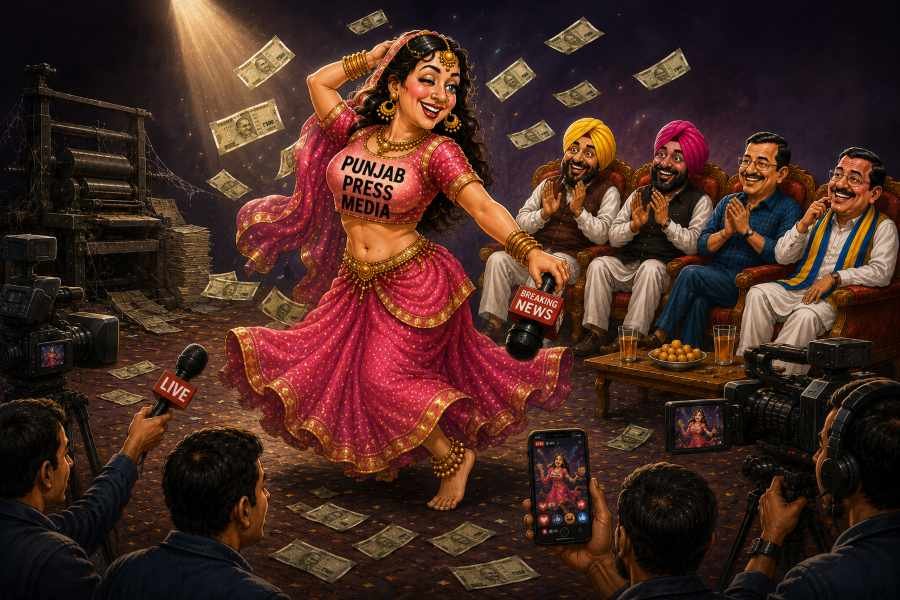
THERE ARE MOMENTS in the life of a democracy when the story is no longer about a politician, a government or even a controversy. The story becomes the institution entrusted with telling that story.
Punjab has reached one such moment.
Yesterday, the biggest story was no longer the controversy itself. The biggest story was how journalism responded to it.
The subject of this editorial is not any one political controversy. It is not about who ultimately proves right or wrong in an ongoing dispute. The real subject is journalism itself—its role, its responsibility and the confidence that society places in it.
George Orwell is often credited with saying,
“Journalism is printing what someone else does not want printed. Everything else is public relations.”
Justice Hugo Black reminded us that
“The press was to serve the governed, not the governors.”
Joseph Pulitzer warned that
“Our Republic and its press will rise or fall together.”
Walter Lippmann observed that
“There can be no higher law in journalism than to tell the truth.”
These are not merely quotations to adorn journalism classrooms. They are enduring principles by which every newsroom is ultimately judged. A free press is not expected to be infallible. It is expected to be fair. It is expected to pursue every important development with equal sincerity, irrespective of whom it benefits or embarrasses.
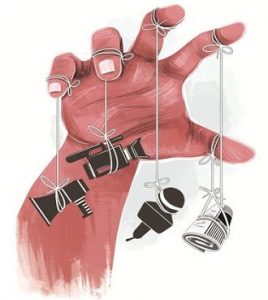
Journalism does not end when the first headline is published; it begins there. The real test of journalism is not how it reports the beginning of a story, but whether it has the courage to report every chapter that follows.
The recent controversy surrounding a viral video involving Punjab Chief Minister Bhagwant Mann unfolded in several stages. Initial allegations were followed by official responses, competing claims, forensic reports and later investigative developments. Those developments entered the public domain and generated widespread public discussion.
Whether the competing allegations are ultimately established or rejected is for the investigating agencies and the courts to determine.
That, however, is not the concern of this editorial.
The issue is no longer Bhagwant Mann. It is no longer Bikram Singh Majithia. It is no longer Harpal Cheema. It is no longer Sukhpa Khaira. The issue is journalism itself.
The concern is whether every material stage of an evolving public controversy receives balanced journalistic attention. The concern is whether the press follows the entire story with the same commitment with which it reports its opening chapter.
When the Akal Takht Spoke to the Press
It is against this backdrop that the communication issued by the Secretariat of Sri Akal Takht Sahib assumes extraordinary significance.
For perhaps the first time in recent memory, the Secretariat did not primarily address a government. It did not direct its message to any political party. Instead, it addressed Press Club Chandigarh, Press Club Amritsar, Punjab Press Club Jalandhar and the Punjab & Chandigarh Journalists Union.
That fact alone should have prompted serious introspection in every newsroom across Punjab.
Also Read: POWER PRESSES PRESS
When one of the most respected institutions of the Sikh community finds it necessary to remind journalists of the constitutional role of the media, the issue is no longer merely political. It becomes institutional.
Referring to the developments that followed the laboratory report controversy and the subsequent registration of the Gurugram Police FIR, the Secretariat expressed concern that these developments had not received due publicity in sections of the Punjabi and digital media.
It further observed that, despite issuing its own official statement, a large section of the media had not carried the Secretariat’s version.
The communication then reminded the media of a principle that should never require repetition:
“The media is regarded as the Fourth Pillar of Democracy. Therefore, it is the duty of the media to place important developments before society.”
It went further by cautioning:
“If, under any pressure, important public-interest news is not published, then the media is not properly discharging its responsibility.”

Akal Takht Sectt Letter
These are not the words of an opposition leader seeking political advantage. They are not the words of a ruling party defending itself. They are the considered observations of the Secretariat of Sri Akal Takht Sahib, addressed directly to journalists, editors, media organisations and Press Clubs.
Think about the gravity of that.
When one of the highest temporal institutions of the Sikh community finds itself reminding journalists what journalism means, it is not merely commenting on a controversy. It is expressing concern about the health of an institution upon which democracy itself depends.
The Secretariat did not ask the media to support one political party. It did not ask the media to oppose another. It asked the media to report. There is a profound difference between the two.
The role of journalism is not to validate one narrative or invalidate another. It is to verify facts, present competing viewpoints and ensure that citizens receive sufficient information to reach their own conclusions.
Readers may disagree politically, but they are entitled to expect that significant developments of public importance will be placed before them fairly, completely and without fear or favour.
When an institution of such standing finds itself reminding journalists of the first principles of journalism, the issue is no longer merely political.
It becomes institutional.
Can the Public Still Trust the Fourth Estate?
Ultimately, journalism is judged by one simple question: Can the public trust it?
Trust is journalism’s only permanent capital. Everything else is temporary. Governments change. Political fortunes rise and fall. Advertising revenues fluctuate. Circulation figures expand and shrink. Television ratings soar one day and collapse the next. Even digital popularity is fleeting.

Credibility alone endures, and once it is lost, no marketing campaign, corporate investment or political patronage can restore it.
Punjab has inherited a proud and courageous journalistic tradition. Its newspapers and journalists have chronicled the State through some of its darkest chapters. They exposed terrorism, corruption, abuse of authority and social injustice.
Many journalists paid a heavy personal price for their commitment to truth, facing intimidation, imprisonment and, in some cases, sacrificing their lives. They understood a principle that should remain the guiding light of every newsroom: the purpose of journalism is not to make the powerful comfortable, but to make the powerful answer uncomfortable questions.
That legacy must never be forgotten.
 The Fourth Estate was never created to entertain governments or amplify official narratives. Its constitutional role is to question power, verify competing claims, scrutinise those who hold public office and ensure that citizens receive sufficient information to form their own independent judgments. Journalism serves neither the rulers nor the opposition; it serves the public’s right to know.
Readers are far more discerning than many editors imagine. They notice not only what appears in bold headlines but also what is omitted. They notice emphasis. They notice silence. They remember inconsistencies. Every editorial decision, every front page and every unexplained omission either strengthens or weakens public confidence in the press.
Also Read: Press Freedom Is Not a Shield for Business Interests
In the end, newspapers are remembered not only for the stories they publish, but also for the stories they choose not to tell.
Journalism derives its authority neither from power nor from proximity to power. It derives its authority from public trust. Once that trust begins to erode, democracy itself pays the price.
A Challenge to the Press Clubs
The Akal Takht Secretariat’s communication is therefore more than a letter arising out of a particular controversy. It is a challenge to every Press Club that received it.
Press Clubs have historically stood as guardians of press freedom. They defend journalists against intimidation, speak whenever governments attempt to silence the media and safeguard the independence of the profession. That responsibility remains indispensable.
Also Read: PRESS FREEDOM
But there is another responsibility that is no less important—to defend journalism from the gradual erosion of its own standards. Freedom of the press and responsibility of the press cannot be separated. One cannot survive without the other.
History Will Deliver the Final Verdict
India’s democratic history offers an enduring reminder. During the Emergency came the unforgettable observation that “the press was asked to bend, but it crawled.”
History preserved that sentence because institutions are ultimately judged not by the ideals they profess, but by the choices they make when those ideals are tested.

History is patient. It watches quietly. It records faithfully. And, in time, it delivers its verdict without passion.
Governments come and go. Chief Ministers come and go. Political parties rise and fall. Editors retire. Media owners change.
Newspapers remain. Archives remain. Headlines remain. History remains.
Years from now, today’s controversies will have faded into history. What will endure is the record of how journalism responded. Future generations will not ask which political party a newspaper supported or opposed. They will ask a far simpler question:
When important public questions demanded honest, balanced and fearless journalism, did the Fourth Estate fulfil the responsibility entrusted to it?
History is an unforgiving editor.
It deletes excuses. It preserves courage.
And it never forgets those who chose silence when the public deserved the whole story.