
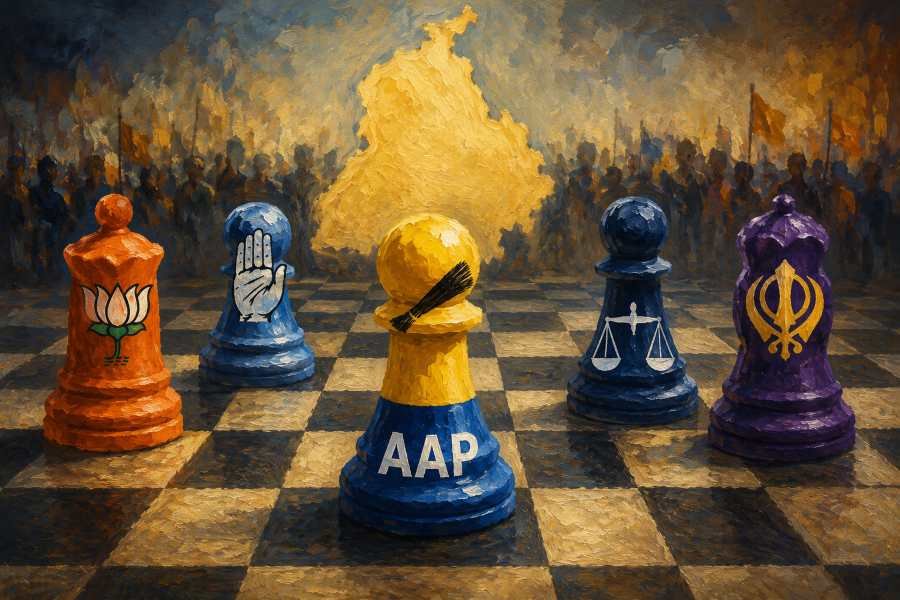
How Congress, a possible BJP-SAD alliance and the emerging Panthic space may fare in the contest.
PUNJAB’S 2027 Assembly election is still months away, but the contours of the contest are becoming clearer. AAP cannot yet be written off, but neither can it assume that the political conditions that produced its extraordinary 92-seat victory in 2022 still exist.
The central question is not simply whether AAP faces anti-incumbency. It is whether any anti-incumbency can be converted into Assembly seats by an opposition that remains divided among Congress, BJP, SAD and a range of smaller and Panthic forces. That makes the relationship between the BJP and Shiromani Akali Dal one of the most consequential unresolved questions of the election.
That question, however, has become more complicated in the past few days. Sukhbir Singh Badal’s meeting with Prime Minister Narendra Modi had revived speculation about a possible BJP-SAD rapprochement. But on August 24, BJP national general secretary (organisation) B.L. Santosh said the BJP would contest all 117 Assembly seats on its own and form the government in Punjab.
The statement effectively makes a solo BJP contest the present baseline, although political negotiations can never be treated as permanently closed this far ahead of an election.
The 2027 contest, therefore, is best understood not as a settled four-cornered race, but as a contest in which AAP, Congress and BJP are presently the principal statewide forces, SAD is fighting to recover relevance, and a separate Panthic space could influence the outcome in a number of constituencies.
Five years after the AAP wave
AAP won 92 of Punjab’s 117 Assembly seats in 2022 with 42.01 per cent of the vote. Congress was reduced to 18 seats, SAD won three and BJP two. It was an exceptional electoral realignment.
Voters will be assessing the complete five-year record of the Bhagwant Mann government rather than voting primarily for change against the previous establishment.
 That does not mean AAP is necessarily headed for defeat. The party retains substantial advantages: a statewide organisation, an established Chief Ministerial face in Bhagwant Mann and the organisational advantages that come with incumbency.
But it is now defending five years of governance rather than campaigning on the promise of change. That makes 2027 a fundamentally different election for AAP.
The more important question is whether AAP can retain the broad coalition that carried it to 92 seats. The 2022 result brought together voters who wanted an alternative to the established Congress-SAD order, as well as sections of the electorate that had traditionally voted for SAD or Congress. Five years later, those voters have several more destinations.
The 2024 Lok Sabha result is a warning, not a forecast
The 2024 Lok Sabha election provides the most recent statewide measure of competitive party strength, but it cannot be mechanically projected onto the 2027 Assembly election.
Congress secured 26.30 per cent of the vote and won seven of Punjab’s 13 Lok Sabha seats. AAP secured 26.02 per cent and won three. BJP polled 18.56 per cent but won no seat, while SAD polled 13.42 per cent and won one. Two Independents also won seats.
But a Lok Sabha election is not a Vidhan Sabha election. The 2024 contest was fought substantially in the context of national politics, the Narendra Modi government and national political alignments.
 The 2027 Assembly election will be much more directly about the Mann government’s five-year record, Punjab-specific governance, local candidates, constituency equations, agriculture, employment, law and order, welfare and regional and Panthic issues.
The 2027 voter will also be making a decision five years after the 2022 Assembly election, rather than two years into the Mann government, as was the case during the 2024 Lok Sabha election. The 2024 figures therefore provide an important baseline, not a ready-made 2027 forecast.
One number nevertheless deserves particular attention. Despite winning no Lok Sabha constituency, BJP led in 23 of Punjab’s 117 Assembly segments in the 2024 parliamentary election. Congress led in 37 and AAP in 33.
The BJP figure is particularly significant because it shows that the party’s statewide vote share was not merely dispersed uniformly across Punjab. It had already developed pockets of substantial constituency-level strength.
That creates a central BJP question for 2027:
Can it convert vote share and constituency-level leads into Assembly seats?
BJP’s problem is vote conversion
BJP’s 2024 performance illustrates a fundamental principle of first-past-the-post elections: statewide vote share and seats won are not the same thing.
The party’s 18.56 per cent vote share was substantial, yet it won zero Lok Sabha seats. At the Assembly-segment level, however, BJP led in 23 constituencies, underlining the pockets of electoral strength it had developed in Punjab during Sunil Jakhar’s tenure as state president.
 That suggests that BJP has built a meaningful electoral base, particularly in urban and semi-urban areas, but still faces a geographical and constituency-level conversion problem.
A party can increase its statewide vote share without gaining many seats if its additional votes are concentrated in constituencies where it remains second. Conversely, relatively modest shifts in the right constituencies can produce a disproportionate increase in seats.
This is why BJP’s 2024 result should neither be dismissed because it produced no Lok Sabha seat nor treated as proof that the party is already capable of winning a large number of Assembly constituencies.
The evidence establishes potential, but not yet a demonstrated Assembly-level conversion.
The August 24 decision to prepare for all 117 seats is therefore significant. It indicates that BJP is no longer treating Punjab simply as a state in which it depends on an alliance partner for statewide relevance. It is attempting to test its own organisational strength across the state.
Congress has the votes, but must convert them into seats
Congress remains the principal statewide challenger to AAP. Its 26.30 per cent vote share and seven Lok Sabha seats in 2024 provide a substantial electoral base.
But its route to power is different from BJP’s.
Congress does not necessarily need to dominate every region. It needs to retain its statewide base, improve candidate-level performance, consolidate anti-AAP votes in enough constituencies and prevent BJP, SAD and Panthic candidates from dividing the opposition vote where Congress is the principal challenger.

That makes leadership and factionalism important variables. Congress has an established organisation and a broad statewide presence, but internal divisions, leadership competition and candidate selection could determine whether its vote share translates into seats.
Congress also cannot assume that every voter dissatisfied with AAP will automatically move to it. BJP is expanding its reach, SAD is attempting to recover its traditional space and emerging Panthic forces are competing for a section of the electorate that might otherwise become part of an anti-incumbent consolidation.
Congress therefore faces a vote-consolidation and seat-conversion problem, rather than simply a vote-share problem.
AAP’s incumbency test is becoming more complicated
AAP’s challenge is not conventional anti-incumbency alone. Several otherwise separate issues are now capable of feeding into the broader narrative surrounding five years of Mann government.
The first is the dispute over Dearness Allowance and Dearness Relief for Punjab government employees and pensioners.
On August 3, the Punjab and Haryana High Court dismissed appeals filed by the Punjab government and PSPCL and directed release of pending DA/DR dues within a fortnight.
The Court also directed that until the dues were cleared, the state should not resort to “unproductive expenditures” such as large-scale advertising campaigns in print or social media. It directed the Chief Secretary to ensure compliance and file an affidavit by August 31.
 The issue has since moved beyond a legal dispute. The stipulated fortnight ended on August 17, and a contempt petition has been filed alleging non-compliance with the High Court’s directions.
The electoral significance is twofold. Government employees and pensioners form a large and politically aware constituency, while the High Court’s direction potentially affects one of the conventional advantages of incumbency: the ability of a government to use public funds for large-scale publicity.
The Court has not prohibited AAP from campaigning as a political party. Its direction concerns government expenditure. But if restrictions on government publicity remain relevant as the political campaign develops, the ruling party may have to depend more heavily on its own political organisation and less on government-funded communication to showcase its record.
For AAP, the DA dispute therefore combines a substantive grievance with a communication problem.
The Akal Takht confrontation
The government’s political vulnerability is not confined to administration and employee grievances. The confrontation between Bhagwant Mann and the Akal Takht has introduced a far more sensitive dimension.
On June 15, the five Sikh high priests at the Akal Takht declared Mann “Guru Dokhi” and “Khalsa Panth Virodhi” over the controversy surrounding a video.
 The Akal Takht said forensic reports had found the video authentic and not AI-generated. Mann has consistently denied being the person shown in the video and has disputed the allegations.
The electoral significance should not be exaggerated. A religious censure does not automatically translate into votes, and Punjab’s electorate cannot be treated as a homogeneous religious bloc.
But the controversy creates a political vulnerability that did not exist in this form in 2022. It gives SAD and emerging Panthic forces an issue that goes beyond conventional anti-incumbency and directly touches questions of religious authority, political credibility and Sikh institutional identity.
For AAP, the risk is not that every Sikh voter will treat the Akal Takht’s position as an electoral instruction. The risk is that the controversy reinforces a narrative of political distance between the Mann government and sections of the Panthic electorate, particularly among voters whom AAP had drawn away from the traditional Akali base.
The ED’s CMO allegations
A second controversy has placed the Chief Minister’s Office itself under scrutiny.
The Enforcement Directorate has written to Punjab DGP Gaurav Yadav alleging 61 instances of wrongdoing involving matters including transfers and postings, policy decisions, tenders, land dealings and arms-licence procurement, and has sought registration of an FIR against people it alleges are associated with Rajbir Singh Ghuman, an OSD to the Chief Minister.
 These remain allegations, not established findings.
Bhagwant Mann has rejected the allegations as baseless and accused the BJP of using central agencies against political opponents.
Electorally, the significance lies less in the allegations themselves than in where they are directed. Allegations involving people close to the centre of government can become politically damaging if they reinforce an opposition narrative about access, influence and governance.
AAP, however, has an equally obvious counter-narrative: that the ED is being used as a political instrument against an elected state government.
The electoral effect will therefore depend heavily on whether the matter produces further investigation or evidence, or remains part of the larger political confrontation between the Union government and Punjab.
The NHRC controversy involving the Chief Minister’s wife
The latest controversy is even more sensitive.
The National Human Rights Commission has taken cognisance of a complaint containing allegations against Chief Minister Bhagwant Mann’s wife, Gurpreet Kaur, in connection with an alleged demand for money to suppress a rape case. She has denied the allegation and has issued a legal notice to retired Punjab and Haryana High Court judge Ranjit Singh, who made the allegation.

The NHRC has directed the Punjab Chief Secretary and DGP to inquire/investigate and submit an Action Taken Report within two weeks.
Again, the distinction is essential: the allegation is not a finding of wrongdoing.
For AAP, however, the political risk is one of perception and association. The matter does not establish wrongdoing by the Chief Minister or his government. But elections are also fought on questions of credibility, access to power and the conduct of people perceived to be close to those in power.
Whether this becomes a substantive political liability will depend on what the inquiry establishes and how effectively AAP responds.
Taken together, these controversies do not justify predicting an AAP defeat. Their significance lies in their cumulative potential.
AAP enters the next election having to defend not only its record of governance, but also its credibility on administration, transparency, institutional relationships and political conduct.
The Panthic space is no longer just a protest vote
The changing shape of Panthic politics could be one of the most important variables in the 2027 election.
The issue is no longer simply whether SAD can recover its traditional Sikh vote. A new electoral formation around Akali Dal (Waris Punjab De), led by Khadoor Sahib MP Amritpal Singh, is attempting to establish an independent political base alongside the older Akali formations.

The significance first became visible in the 2024 Lok Sabha election, when Amritpal Singh won Khadoor Sahib by 1,97,120 votes and Sarabjit Singh Khalsa won Faridkot by 70,053 votes. Both contested as Independents.
Those victories demonstrated that candidates outside the established parties could mobilise substantial support around a combination of Sikh identity, Bandi Singhs, sacrilege-related issues, drugs, unemployment and a broader sense of political alienation.
But the 2025 Tarn Taran Assembly by-election provided an important corrective to any assumption that the 2024 results would automatically translate into Assembly seats. The candidate backed by Amritpal’s organisation finished third with 19,620 votes, behind AAP and SAD. The result showed that Panthic mobilisation can be significant without necessarily producing an Assembly victory.
Since then, Waris Punjab De has moved beyond symbolic politics and begun building an electoral organisation. Three-time Dakha MLA Manpreet Singh Ayali joined the organisation in June, giving it an elected Assembly politician with an established constituency base. Ayali has also advocated Panthic unity and ruled out an alliance with BJP.
The organisation has also begun announcing candidates for the next Assembly election, including Pappalpreet Singh from Majitha.
That changes the electoral calculation.
The question is no longer simply whether the Panthic space exists. It is how much of that space can be converted into Assembly seats, and from which parties those votes will come.
For SAD, the development presents both an opportunity and a threat. A broader Panthic consolidation could revive a political constituency in which SAD historically had an advantage. But if Waris Punjab De establishes itself as a separate pole, it could prevent SAD from reclaiming the entire traditional Akali vote.
For AAP, the implications could be equally important. The party’s 2022 expansion cut deeply into the traditional SAD vote, including in rural and Sikh-majority constituencies. A revival of Panthic voting could therefore erode some of AAP’s support in constituencies where it previously benefited from fragmentation of the Akali base.
Congress faces a different problem. A portion of the anti-AAP vote that might otherwise consolidate behind Congress could instead move towards Panthic candidates in constituencies where identity and religious issues become dominant.

The picture is therefore not of a single consolidated Panthic bloc. It is of multiple forces competing to occupy the same political space.
If these forces remain divided, they could collectively influence the result while winning relatively few seats themselves. If they achieve meaningful coordination in selected constituencies, particularly in Majha and parts of Malwa, they could become a consequential fourth electoral force without necessarily becoming the principal opposition party.
The Panthic vote should therefore not be treated as a fixed bloc or as a simple extension of the SAD vote. Its significance will depend on candidate selection, constituency-level concentration, organisational consolidation and whether voters prioritise Panthic identity over governance and other local issues.
Local elections show organisation, but they are not opinion polls
AAP’s performance in the recent local elections is politically significant.
In the December 2025 Zila Parishad elections, AAP won 218 of 346 zones. Congress won 62, SAD 46 and BJP seven. In the Panchayat Samiti elections, AAP won 1,529 of the 2,834 zones for which results were declared by the State Election Commission.
In the May 2026 municipal elections, AAP won 958 of 1,977 wards, Congress 397, Independents 251, SAD 192 and BJP 172. AAP won five of the eight municipal corporations.
On the face of it, these results demonstrate substantial AAP organisational and mobilisation capacity.
But they should not be treated as direct measures of AAP’s 2027 Assembly vote share.
There are two reasons. Local elections have different issues, candidates and turnout patterns. More importantly, serious questions have been raised about the conduct of the Patiala Municipal Corporation election.
 The Supreme Court constituted a fact-finding committee headed by former Punjab and Haryana High Court judge Justice Nirmaljit Kaur to examine allegations concerning the election. The committee submitted its report to the Supreme Court in November 2025, and the report has since been made public.
The report has brought allegations concerning the nomination process and the conduct of the Patiala municipal election across a number of wards into the public domain, although the Supreme Court is yet to determine what action, if any, should follow from the committee’s findings.
That distinction is important. The findings of a fact-finding committee should not be presented as a final judicial determination. But the very fact that the Supreme Court considered it necessary to appoint such a committee, and that its report is now in the public domain, makes it difficult to treat the local-election results as an uncomplicated measure of political support.
The right analytical conclusion is therefore narrower: local elections provide evidence of organisational capacity and political mobilisation, but are a much less reliable guide to statewide Assembly voting intention.
BJP and SAD: the question that could still change the arithmetic
For now, BJP’s declared position is clear: it intends to contest all 117 seats on its own. That is the political baseline as of August 25.
But the BJP-SAD question remains worth examining because the two parties have a long electoral history, and because a reunion would alter the opposition arithmetic considerably.
The two parties were long-standing allies before breaking over the farm laws. They contested the 2022 Assembly election separately, with SAD winning three seats and BJP two. In 2024, BJP contested all 13 Lok Sabha seats and substantially increased its vote share, while SAD’s vote share declined.
The recent meeting between Sukhbir Singh Badal and Narendra Modi revived speculation about a reunion. SAD leaders have also continued to speak about the possibility. But BJP’s latest public declaration that it will contest all 117 seats means an alliance should now be treated as a contingency scenario rather than the present electoral arrangement.
Why a BJP-SAD alliance would be consequential
On paper, the two parties possess complementary strengths. BJP has developed a substantial urban and semi-urban vote base. SAD retains a deeper rural and Panthic network than its present statewide vote share alone might suggest.
But their 2024 vote shares cannot simply be added.

BJP’s 18.56 per cent plus SAD’s 13.42 per cent equals 31.98 per cent mathematically. It does not follow that a BJP-SAD alliance would receive 31.98 per cent in an Assembly election.
Vote transfer between parties is never automatic. Some SAD voters may not vote for BJP candidates. Some BJP voters may not vote for SAD candidates. And a portion of the old SAD vote has already moved to AAP, Congress and independent or Panthic candidates.
The 2024 election demonstrated this fragmentation, with Amritpal Singh and Sarabjit Singh Khalsa winning Lok Sabha constituencies as Independents.
An alliance would therefore face two separate tests:
Can the two parties combine their complementary strengths?
And:
Can they transfer enough of their respective votes to one another without losing voters to other parties?
In a first-past-the-post election, an alliance’s strength depends not only on the total votes its partners possess, but also on whether those votes transfer between partners and whether the combined vote is concentrated in constituencies where it can produce a plurality.
Seat-sharing could be as important as the alliance itself
The old BJP-SAD arrangement cannot simply be restored from the past.
 BJP’s 2024 vote share was higher than SAD’s. The party has also spent the intervening period building its own organisation in Punjab. SAD, meanwhile, cannot easily surrender constituencies in which it has historically maintained a strong network.
A future alliance would therefore have to resolve not merely whether the parties will cooperate, but how many seats each will contest and which constituencies each will receive.
An arrangement in which each party contests constituencies best suited to its own vote base could improve seat conversion. An arrangement based largely on historical seat-sharing formulas could produce a very different result.
The Panthic vote complicates the BJP-SAD calculation
SAD’s greatest potential advantage in an alliance is also one of its biggest uncertainties.
The party retains the strongest historical claim to the Panthic political space. But that space is no longer monopolised by SAD.
The emergence of Waris Punjab De has created a separate electoral pole. An alliance with BJP could consolidate some of SAD’s traditional vote, but it could also push voters uncomfortable with BJP towards alternative Panthic candidates.
This is one reason why BJP plus SAD does not necessarily equal BJP vote plus SAD vote.
A BJP-SAD alliance could therefore strengthen the opposition’s overall arithmetic while simultaneously creating a Panthic flank that prevents complete consolidation.
Three regional battlegrounds
Malwa: the principal seat-count battleground
Malwa has 69 of Punjab’s 117 Assembly seats and remains the largest determinant of the eventual seat arithmetic.

AAP’s 66-seat sweep of Malwa in 2022 is unlikely to be repeated at the same scale. The crucial question is where any lost seats go.
If Congress captures most of them, Congress becomes the principal challenger. If the seats are divided among Congress, BJP, SAD and Panthic candidates, AAP could remain the largest party even after losing substantial ground.
This is why statewide vote share alone will tell only part of the story.
Majha: the Panthic and alliance battleground
Majha could become the most important laboratory for the changing Panthic arithmetic.
The region combines Congress’s established presence, AAP’s 2022 expansion, BJP’s urban strength and the competing claims of SAD and Waris Punjab De.
The nomination of Pappalpreet Singh for Majitha is an early indication that Waris Punjab De intends to contest seriously rather than merely influence the election from outside.
A BJP-SAD alliance could make several contests substantially tighter, but it could also leave a distinct constituency for Waris Punjab De or other Panthic candidates among voters unwilling to transfer their support to an alliance involving BJP.
Majha could therefore become the region where the consequences of Panthic fragmentation versus Panthic consolidation are most visible.
Doaba: the multi-cornered battleground
Doaba is particularly complicated because of its social composition and the competing bases of Congress, AAP, BJP, SAD and BSP.
BSP remains relevant in selected constituencies, particularly in a region where the Scheduled Caste electorate is politically significant. BJP’s expanding urban and Dalit outreach, Congress’s traditional base and AAP’s organisational presence can interact very differently here from the rural Sikh-majority arithmetic of parts of Majha and Malwa.
Relatively small shifts between parties can therefore change constituency outcomes without producing a dramatic statewide change in vote share.
What happens if BJP and SAD remain separate?
The anti-AAP vote would remain divided among Congress, BJP, SAD and other candidates, giving AAP the strongest structural chance of emerging as the largest party.
But the exact outcome would depend heavily on candidate selection, constituency-level contests and the extent of vote movement between parties.
What changes if BJP and SAD unite?
This remains a useful contingency for understanding how the electoral arithmetic would change if the two parties eventually reached an agreement.
The anti-AAP vote would no longer be divided between two of the principal opposition parties. A BJP-SAD alliance would bring together BJP’s urban and semi-urban base with SAD’s traditional rural and Panthic networks, potentially making the alliance a much more formidable constituency-level challenger.
That does not automatically make the alliance the favourite. It would, however, weaken one of AAP’s most important structural advantages.
The principal contest could then become:
AAP vs BJP-SAD vs Congress
while a separate Panthic force, particularly Waris Punjab De, could continue to draw votes from all three, especially in constituencies where Panthic issues are dominant.

The result could therefore be a three-way principal contest with a significant fourth electoral force, rather than a conventional four-way contest.
Waris Punjab De has demonstrated organisational expansion and electoral intent, but the Tarn Taran experience also showed the difficulty of converting Panthic mobilisation into Assembly seats.
The question is therefore not simply how many votes a Panthic force may receive, but whose prospects those votes weaken in closely fought constituencies.
The possibility of a hung Assembly could therefore increase.
Congress could remain highly competitive even if it were not the largest party, because its statewide vote base could determine the outcome in closely fought constituencies. A separate Panthic contest could make that arithmetic even more unpredictable by preventing anti-AAP votes from consolidating behind either Congress or BJP-SAD.
For BJP-SAD, an alliance would therefore not merely be another electoral arrangement. It would be an attempt to change the structure of the election itself.
What can reasonably be predicted today?
A responsible psephological assessment in August 2026 has to recognise the limits of the available evidence.
 There is no constituency-level opinion poll that would justify a precise 117-seat forecast. There are no final candidates across the major parties. And the BJP-SAD alliance remains hypothetical, with BJP presently declaring that it will contest all 117 seats independently.
The 2024 Lok Sabha results cannot be directly converted into Assembly results. The 2025-26 local-election results provide useful organisational signals but cannot be treated as statewide opinion polls.
Accordingly, any seat numbers at this stage would be analytical scenario ranges, not poll-based forecasts.
The more useful question is therefore what each party needs to achieve.
AAP
AAP needs to defend its 2022 coalition, limit erosion of its rural and Sikh-majority support, demonstrate a credible five-year governance record and prevent disparate opposition forces from converting anti-incumbency into a single electoral wave. Its greatest advantage remains a divided opposition; its greatest risk is that governance grievances and controversies converge into a broader narrative of incumbency.
Congress
Congress has the strongest recent statewide alternative vote base among the traditional opposition parties, but its challenge is to convert that support into constituency-level victories. Internal divisions, candidate selection and the presence of competing opposition forces could determine whether its vote share translates into seats.
BJP
BJP has demonstrated a significant statewide vote base and led in 23 Assembly segments in 2024. Its challenge is to turn that strength into a geographically broader Assembly presence as it prepares to contest all 117 seats.
SAD
SAD’s challenge is more fundamental: can it recover enough of its traditional political space to become indispensable to the next government?
A BJP alliance could accelerate that process, but it could also expose SAD to a new Panthic challenge.
Waris Punjab De and the wider Panthic space
The emerging Panthic forces have demonstrated the ability to win parliamentary constituencies and attract established political figures. Their challenge is to convert that mobilisation into Assembly seats—or influence the result indirectly by preventing AAP, Congress or SAD from consolidating votes in closely contested constituencies.
AAP faces a tougher test, but 2022 is no longer the template
That is the most defensible conclusion at this stage.
 AAP remains the state’s strongest single electoral force on the evidence of its 2022 Assembly victory and subsequent statewide organisational performance. But it is entering the election after five years in office, in a political environment very different from the one that produced its 92-seat victory.
The emergence of Waris Punjab De, the electoral performance of Amritpal Singh and Sarabjit Singh Khalsa, the entry of Manpreet Singh Ayali and the continuing attempts at Panthic consolidation have created a separate variable that could influence the result even without becoming the largest political force.
The most important unresolved question is therefore not simply who is ahead today.
It is:
Can AAP’s opponents convert a fragmented anti-incumbent vote into a workable electoral alignment, or will the division among Congress, BJP, SAD and Panthic forces allow AAP to remain the largest party even after losing substantial ground?

If BJP and SAD remain separate, AAP retains a significant structural advantage. If they eventually reunite, the map changes, but the alliance would still have to overcome uncertain vote transfer, difficult seat-sharing and the possibility that a separate Panthic force prevents complete opposition consolidation.
The 2027 election is therefore unlikely to be decided simply by the size of AAP’s anti-incumbency. It will be decided by how that discontent is distributed among Congress, BJP, SAD and the emerging Panthic forces — and by which of them can convert fragmented support into constituencies won.
The most important question is not who is ahead in Punjab, but who can build the electoral alignment capable of turning the next election into a change of government. 
____________
Editor’s Note
This is an analytical assessment, not an opinion poll or constituency-level seat forecast. It draws primarily on the 2022 Punjab Assembly election, the 2024 Lok Sabha election and constituency-level results, subsequent political developments, recent local-election results and publicly documented developments affecting the principal parties.
The 2024 Lok Sabha results are treated as a recent measure of party strength, not as a direct projection of Assembly voting intention. Local-election results are treated principally as indicators of organisational capacity and mobilisation, rather than as statewide opinion polls, particularly in view of judicial scrutiny surrounding aspects of the local electoral process.
The BJP-SAD alliance is analysed as a contingency scenario. As of August 25, 2026, BJP has publicly stated that it intends to contest all 117 Assembly seats on its own, while speculation about a possible rapprochement with SAD has not completely disappeared. No current opinion poll is being used to manufacture a 117-seat projection.