
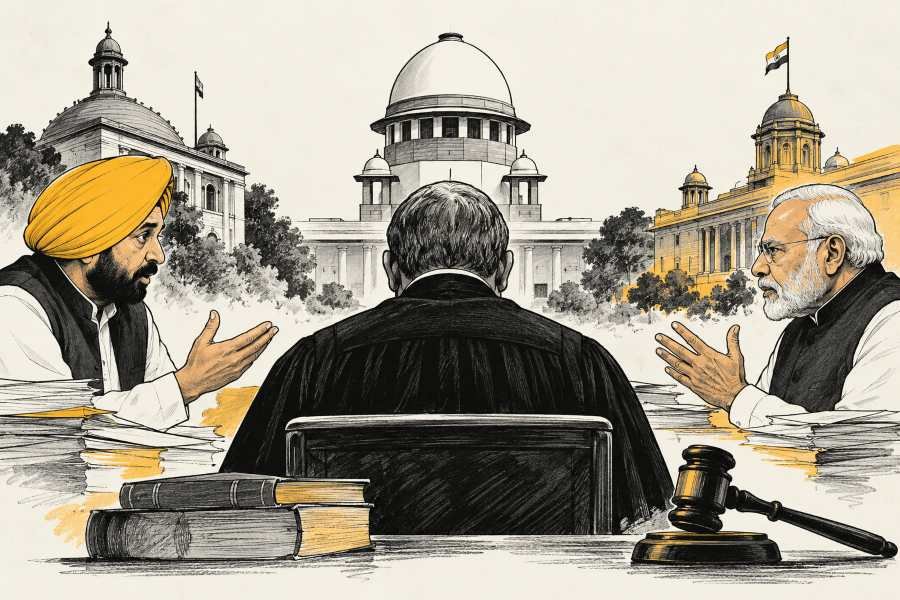
THE APPOINTMENT OF Justice Ashwani Kumar Mishra as Chief Justice of the Punjab and Haryana High Court has triggered an unusual confrontation between the Punjab government and the Centre.
The Punjab government has objected to the appointment, arguing that the Centre proceeded without obtaining and considering the State’s views. The Union government, on the other hand, has maintained that consultation with the State does not amount to a requirement of consent or give the State a veto over the appointment.
Justice Mishra nevertheless took oath as Chief Justice on September 7, 2026.
The immediate dispute is therefore about more than one judicial appointment. It raises questions about the constitutional process for appointing a High Court Chief Justice, the meaning of consultation between the Union and a State government, the conduct of both governments during that process, and, ultimately, the independence of the judiciary.
What is Punjab objecting to?
Punjab’s objection appears to centre on the manner in which the appointment process was completed.
The State has maintained that its constitutional role was bypassed and that the Centre did not wait for Chief Minister Bhagwant Mann’s response before proceeding with the appointment.

Justice Ashwani Kumar Mishra
Reports have also indicated that Punjab’s objections extended beyond the appointment procedure, with the State raising concerns about past judgments involving Punjab.
These are two separate issues.
If the State’s complaint is that the prescribed consultation procedure was not properly followed, that is a question of constitutional and administrative procedure and deserves to be examined on its own merits.
If, however, the opposition to the appointment is substantially based on dissatisfaction with judgments delivered by the judge, a different and more difficult question arises: can a government legitimately oppose the elevation of a judge because it disagrees with decisions affecting the government?
A government is entitled to challenge an adverse judgment through lawful remedies. Judicial decisions do not become evidence of judicial bias merely because they inconvenience the executive.
That distinction becomes particularly important when the larger principle of judicial independence is considered.
Why did Punjab keep its response pending?
The reported timeline raises questions about the Punjab government’s own conduct.
The Supreme Court Collegium recommended Justice Ashwani Kumar Mishra as Chief Justice of the Punjab and Haryana High Court on August 6. Reports say the Centre sought the views of the concerned State governments on August 10, while the Punjab government’s own account says it received the communication seeking its views on August 12. The Centre notified the appointment on September 5, and Justice Mishra took oath on September 7.
In other words, even on Punjab’s own account, the State had more than three weeks between receiving the Centre’s communication and the notification of the appointment.
This leads to an obvious question: If Punjab had serious reservations about the appointment, why did it not communicate those objections during that period?
The question becomes even more relevant because the Union government’s side has said that the other States concerned responded promptly, while Punjab’s response remained pending. The Additional Solicitor General, Satya Pal Jain, has said Punjab had sufficient time to communicate its views and that the State had not done so before the appointment was notified.
That does not settle the legal issue in favour of the Centre.
 The fact that Punjab did not respond promptly does not automatically authorise the Centre to disregard a procedural requirement if the applicable Memorandum of Procedure required State views to be obtained before the appointment proceeded.
Equally, the absence of a specific deadline does not mean that a State can remain silent indefinitely and object only after an appointment has been notified.
The legal position depends on the precise requirements of the Memorandum of Procedure, the correspondence exchanged between the parties, the opportunity given to Punjab and the circumstances in which the Centre proceeded.
Punjab should therefore explain when it received the request, whether it communicated any response before September 5, what objections it intended to raise and why those objections were not communicated earlier.
The Centre, for its part, should clarify whether it was legally entitled to proceed after giving the State an opportunity to communicate its views despite the absence of a response.
Constitutional accountability must apply to both governments.
Have recent High Court orders riled Punjab?
There is another aspect of the controversy that deserves closer examination. Have recent orders and proceedings of the Punjab and Haryana High Court contributed to the Punjab government’s dissatisfaction with the judiciary?
The question is not without context. In recent months, the High Court has dealt with a series of matters involving the Punjab government’s finances, administrative functioning, police governance and allegations of corruption. These proceedings are separate from the question of the appointment of the Chief Justice, but they provide relevant context for understanding the atmosphere in which the present confrontation has developed.
The DA/DR dispute and government expenditure
The High Court has dealt extensively with the long-running dispute concerning Dearness Allowance and Dearness Relief for Punjab government employees and pensioners.
On August 3, 2026, the Court directed Punjab to release the pending DA/DR instalments and arrears within the stipulated period. It further directed that, until the dues were cleared, the State should not resort to “unproductive expenditures, such as large-scale advertising campaigns in print or social media”, observing that such expenditure could not justify denial of dues admissible to government employees and pensioners. The Court also directed the Chief Secretary to ensure compliance.
The dispute subsequently acquired another dimension. On September 7, counsel for the applicants alleged that the State had issued full-page advertisements on September 1 despite the Court’s direction and claimed that approximately ₹340 crore had been spent during the current financial year. The State’s counsel pointed to the Supreme Court challenge against the August 3 order.
The matter remained alive in September. The High Court subsequently told the State to pursue its challenge before the Supreme Court and directed it to remove defects in its Special Leave Petition within 10 days. The Court also sought details concerning the schemes, policies and announcements involving financial assistance and other welfare benefits.
The issue raises an important question about the use of public money. Government publicity can serve legitimate purposes, including informing citizens about public schemes and policies. But expenditure on publicity must also satisfy the requirements of necessity, transparency, accountability and public interest.
This assumes particular significance in the context of the Aam Aadmi Party government’s extensive publicity and promotional campaigns, including activities outside Punjab. When public money is involved, questions about whether such expenditure serves a genuine public purpose or political interests deserve careful examination.
The High Court’s scrutiny of government expenditure, however, must be assessed in the context of the precise orders and their legal reasoning. A judicial concern about public funds does not, by itself, establish hostility towards a political party or government.
The Nikhil Saraf PIL and allegations concerning the Chief Minister’s Office
Another significant proceeding concerns a public interest litigation filed by advocate Nikhil Saraf regarding communications sent by the Enforcement Directorate to the Punjab DGP over alleged corruption involving persons linked to the Chief Minister’s Office.
The matter concerns allegations of large-scale and institutionalised corruption, including alleged abuse of official position, criminal conspiracy and manipulation of governmental, tender and administrative processes. The High Court, while hearing the matter, directed the ED to place before it the communications allegedly sent to the Punjab DGP and sought the State’s response. The Bench observed that the nature of the allegations was serious and required a careful response.
The proceedings have also brought into focus allegations concerning private intermediaries, government tenders, policy decisions and official approvals.

Subsequent proceedings have seen the ED again seeking registration of an FIR against private persons and senior Punjab government officials in connection with allegations arising from its investigation into a multi-crore money-laundering and change-of-land-use matter. The ED said in a communication dated August 31 that it had again requested the DGP to register an FIR and provide a copy to the agency.
The High Court has sought responses from the relevant authorities and has required the allegations and the communications between the investigating agency and the State police to be placed before it. The proceedings therefore raise questions about the State’s response to information supplied by a central investigating agency and the manner in which allegations involving persons linked to the Chief Minister’s Office are examined.
The matter also involves questions concerning the maintainability of the PIL and the legal scope of the proceedings. The High Court’s eventual findings and directions will be important in determining the legal and administrative questions raised by the case.
The allegations remain allegations. The filing of a PIL, issuance of notice, or submission of material by an investigating agency does not establish that corruption has been proved.
Nevertheless, the case raises a legitimate public question: When a central investigating agency communicates alleged corruption involving persons linked to the Chief Minister’s Office, what responsibility does the State government have to examine the allegations transparently and communicate the action taken?
Administrative decisions and the functioning of the police
The Court has also been called upon to examine questions concerning Punjab’s administration and police governance.
A recent PIL questioned why Punjab had continued without a regular Director General of Police for more than four years. The High Court has now sought the State government’s response and directed it to file an affidavit. The PIL contends that the continued arrangement under additional charge raises concerns about stable and independent leadership at the highest level of the police force. The matter has been listed for October 1.
The issue is not merely about the identity of an individual police officer. It raises broader questions about institutional stability, accountability and the manner in which a State government manages one of its most important administrative institutions.
The fact that the High Court has entertained such a challenge does not establish that the State government has acted unlawfully. But it does demonstrate that questions concerning the functioning of the Punjab administration and police are increasingly reaching the Court.
Police atrocities and government accountability
Recent public interest litigation and other proceedings concerning alleged police atrocities also warrant attention.
Such cases can raise serious questions about the functioning of law enforcement, the protection of citizens’ rights and the accountability of public officials. The High Court has, in appropriate cases, intervened where allegations concern illegal detention, police misconduct or violations of fundamental rights.
But the precise allegations, judicial observations, directions and present status of each proceeding must be examined before any conclusion is drawn about the government’s conduct or the Court’s findings.
The same principle applies to allegations of corruption or abuse of official power. They require investigation and adjudication through the appropriate legal process.
What do these developments tell us?
The cases discussed above concern different aspects of government functioning. Some involve financial obligations to employees and pensioners. Others concern public expenditure, police administration, institutional accountability or allegations involving persons linked to the Chief Minister’s Office.
They may help explain the political context in which Punjab has raised objections to Justice Mishra’s appointment. They do not, however, establish the government’s motive.
Citizens must distinguish between an adverse judgment and judicial bias. A ruling against a government does not, by itself, establish that the judge is hostile to that government or to the State.
Governments have every right to challenge judicial decisions through lawful remedies. They may also raise genuine objections to an appointment if the prescribed procedure has not been followed. However, dissatisfaction with judicial scrutiny or unfavourable rulings cannot, by itself, be treated as a legitimate ground for questioning a judge’s independence.
The real question, therefore, is not whether the High Court has passed orders inconvenient to the Punjab government. It is whether those orders were legally justified and whether the government’s opposition to the appointment is rooted in a genuine procedural grievance or influenced, even partly, by dissatisfaction with judicial scrutiny.
That distinction is central to the controversy. A government may disagree with a court. It cannot, however, expect the judiciary to be independent only when its decisions are favourable to the government.
The larger constitutional principle
The dispute brings two fundamental principles into focus.
“The judiciary must be independent of the executive and the legislature.”

Judicial independence is a constitutional safeguard intended to ensure that judges decide cases according to the law and the Constitution, without fear of political displeasure or pressure.
A government must be free to challenge a judgment through lawful means. It must also be entitled to raise a genuine objection to an appointment where the prescribed procedure has not been followed.
But the judiciary cannot function independently if judges face political opposition because their decisions are inconvenient to those in power.
The second principle is equally important:
“A government of laws, and not of men.”
This famous formulation, associated with John Adams, captures the essence of constitutional governance. Neither the Union government nor a State government is above the law. Both must follow the procedures that bind them, and both must respect the institutional independence of the judiciary.
That principle cuts both ways. The Union cannot treat consultation as a meaningless formality, and a State cannot treat consultation as an unrestricted veto. The constitutional process must be followed in substance as well as in form.
Ultimately, the strength of the judicial system depends not merely on who appoints a judge, but on whether the institutions involved respect the limits placed upon their own power.
Consultation is not consent
The legal distinction at the heart of the dispute must be understood clearly.
The appointment of a High Court Chief Justice is governed by Article 217 of the Constitution and the applicable Memorandum of Procedure. The Supreme Court Collegium has a central role in recommending judicial appointments, while the Union government processes and notifies appointments within the constitutional framework.
The reported legal interpretation of the Memorandum of Procedure is that the views of the concerned State government are to be obtained, but the State’s consent is not a mandatory precondition for appointment.
If that interpretation is correct, Punjab cannot claim an automatic veto over the appointment. At the same time, a consultation requirement cannot be treated as meaningless. The Centre should be able to demonstrate that the prescribed process was followed and that Punjab was given a meaningful opportunity to place its views before the appointment was finalised.
The distinction is crucial: Consultation requires a meaningful procedural opportunity. It does not necessarily confer a power to veto.
A test for both governments
The controversy offers an opportunity to establish a clearer and more transparent standard for future judicial appointments.
The Union government should explain the procedure followed in Justice Mishra’s appointment. Punjab should disclose the substance and timing of its objections. Both governments should avoid turning a constitutional issue into a partisan confrontation.
The judiciary, meanwhile, must remain insulated from political displeasure. Its legitimacy depends on the confidence that judges decide cases according to the Constitution and the law, not according to the preferences of the government of the day.
Punjab’s objections should neither be dismissed merely because they come from a State government nor accepted uncritically merely because they are framed in the language of federal rights.
The ultimate test is straightforward: Was the appointment process lawful, and are both governments prepared to respect an independent judiciary even when its decisions go against them?
That is the question that deserves an answer, not just in Punjab, but across India