
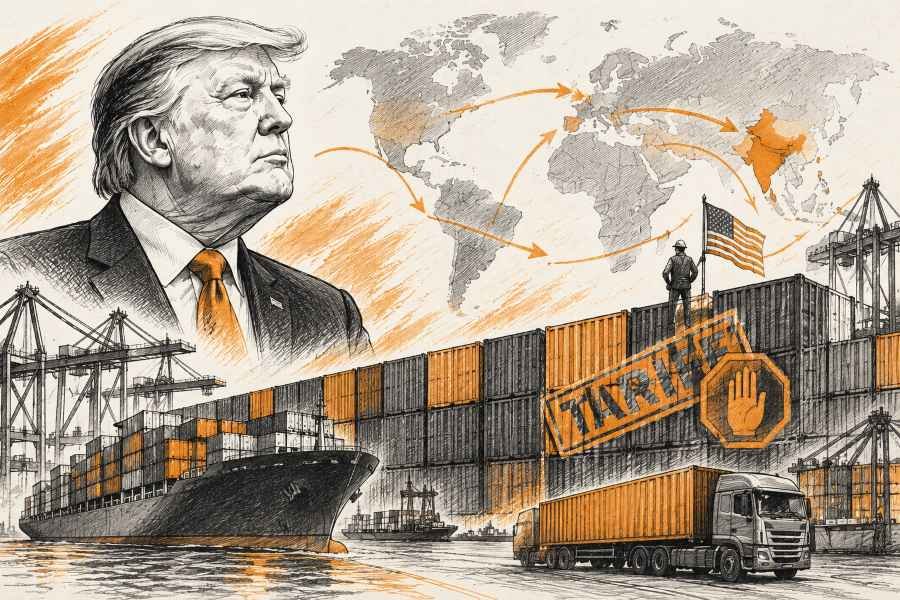
SIX MONTHS AGO, the US Supreme Court dealt Donald Trump‘s trade agenda what appeared to be a fatal blow, ruling that his emergency tariff powers were unconstitutional. Optimists in boardrooms from Frankfurt to Mumbai assumed the tariff era would quietly wind down before the November midterms.
Instead, the past fortnight has delivered the opposite: a “whirlwind week” of new duties, threats and legal manoeuvring that has convinced trade watchers the tariff wall is not crumbling. It is being rebuilt, brick by brick, on more durable foundations.
Trump’s New Tariff Strategy Uses Stronger Legal Foundations
Trump had little patience for lengthy tariff investigations when he returned to office, preferring to hit trading partners immediately to extract concessions. That chaotic approach was eventually undone by the Supreme Court’s ruling this year. His administration has now shifted into a new phase, building a more durable tariff regime using traditional, court-tested trade statutes that it once had little patience for.
 The centrepiece is a new round of 10 to 12.5% duties on 60 countries, justified by their alleged failure to enforce bans on goods made with forced labour. The move is timed precisely to backfill a blanket tariff that Congress declined to renew.
The choice of legal vehicle matters. These new duties rely on Section 301 of the Trade Act of 1974, a law permitting tariffs against countries engaged in “unjustifiable,” “unreasonable” or “discriminatory” trade practices.
Crucially, it allows permanent tariffs without going back to Congress. It is a workaround designed to survive the legal challenge that felled Trump’s IEEPA-based tariffs.
Are Trump’s Tariffs Really Working?
The “forced labour” justification has not survived scrutiny well. If Trump were genuinely targeting forced labour, Japan and New Zealand would not face the same tariffs as China, and there would not be a carve-out for oil and gas imports.
Trade groups make the point more bluntly. The tariffs cover countries responsible for 99% of US imports by value but include fewer than half the nations on the Labour Department’s own forced labour watchlist.
Even Rep. Richard Neal, the top Democrat on the House Ways and Means Committee, called the policy “too convenient to be taken seriously,” warning that it cheapens a genuine human rights issue into a pretext built on “dubious legal theories and personal grievances.”
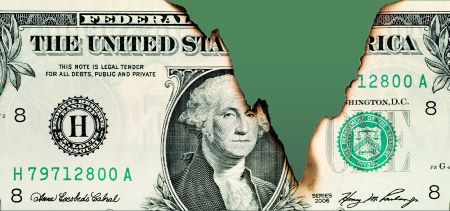 The honest answer is that it depends on what “working” means. On the narrow metric Trump values most, revenue, the numbers are undeniably large. June set a new monthly record with $26.6 billion in customs duties, up from May’s $22.2 billion, bringing the fiscal-year total to $108 billion. Even so, this remains only a small fraction of the $526 billion the US government collects in total monthly receipts.
That growing revenue stream is precisely why some economists now warn that tariffs are becoming structurally embedded. With US public debt nearing $40 trillion, future administrations may become dependent on tariff revenue, making the tariff wall “very durable,” according to Atlantic Council analyst Josh Lipsky. He argues that American financial markets have gone from hating tariffs, to tolerating them, to actively needing them to help cope with mounting deficits.
Rather than “deglobalising” trade to America’s advantage, as Trump promised, critics argue that the world is instead “reglobalising” around trading partners that commit to predictable rules instead of wielding tariffs as instruments of pressure.
Trump’s Trade War and the Psychology Behind It
What makes this tariff campaign distinct from conventional trade policy is how personally Trump appears to experience it. He has repeatedly, almost obsessively, invoked one historical figure: Herbert Hoover. “I never want to be the late, great Herbert Hoover,” Trump told Axios, referring to the president whose 1930 Smoot-Hawley tariffs are widely blamed for deepening the Great Depression.
The irony, as Dartmouth economist Douglas Irwin observed, “just writes itself,” because Trump has now revived the very Smoot-Hawley provision, Section 338, that he claims he wants no part of.

Seal U S Supreme Court
This reflects a broader pattern throughout Trump’s second term: a refusal to accept legal or economic defeat as final. When the Supreme Court struck down his emergency tariffs, economist Paul Krugman observed that Trump’s furious reaction, branding the justices a “disgrace,” reflected an unwillingness to accept limits on executive authority. Instead, he rushed to construct what Krugman described as “zombie tariffs” through obscure legal loopholes before the old ones expired.
For Trump, tariffs function less as carefully calibrated economic instruments than as demonstrations of unilateral authority. They are tools for leverage, punishment and self-vindication as much as they are instruments of trade policy.
Canada’s experience illustrates the pattern. Officials acknowledged that the threat of a 50% tariff was tied not only to trade grievances but also to Canada’s retaliation against earlier US tariffs, demonstrating how Trump uses tariffs as pressure points in both personal and diplomatic disputes.
Global Impact of Trump’s Tariffs and India’s Response
Rather than confronting Washington directly, most trading partners are opting for quiet accommodation. The European Union, despite calling the new forced labour tariffs “unjustified,” is focused on remaining below the 15% cap negotiated under last year’s Turnberry agreement rather than risking open confrontation. As one EU official noted, the bloc’s priority is “stability and predictability” for European companies.
Brazil has been less conciliatory, describing its 12.5% tariff as “arbitrary and unjustified,” while Australia’s trade minister rejected the tariff’s premise outright, insisting that Australia takes modern slavery “seriously.” Across dozens of capitals, the prevailing response has been one of reluctant compliance rather than retaliation, reflecting the calculation that resisting Washington carries greater economic risk than absorbing the levy.
 India’s experience captures this dynamic well. After a difficult 2025, during which combined tariffs on Indian goods reached 50%, a “strategic shock” that one former Indian trade official warned could wipe out India’s long-established presence in the US market, particularly in textiles, gems, jewellery and leather, New Delhi has since worked to de-escalate tensions.
The rate was reduced to a temporary 10% after the Supreme Court ruling. More recently, India secured another concession, lowering the standard 12.5% forced labour tariff to 10% after making last-minute enforcement commitments and amending its foreign trade policy to prohibit imports produced through forced labour.
The damage in 2025 was significant. Indian exports to the United States declined for three consecutive months, including a sharp 16.3% drop in August after Washington doubled tariffs from 25% to 50%. New Delhi’s strategy of rapid compliance rather than confrontation mirrors the approach adopted by Brussels and Tokyo. In Trump’s trade war, the path of least resistance has increasingly become accommodation presented as negotiation.
What ultimately emerges is a tariff regime that is less coherent than durable. It has been patched together through legal workarounds, imposes economic costs on American consumers, and remains psychologically anchored in Trump’s determination to avoid history’s judgment, even at the risk of repeating it.
Whether it ultimately succeeds depends on whose balance sheet one examines: the US Treasury’s, which is undeniably healthier, or the global trading system, which grows increasingly fragmented, uncertain and coercive with every new tariff announcement.