
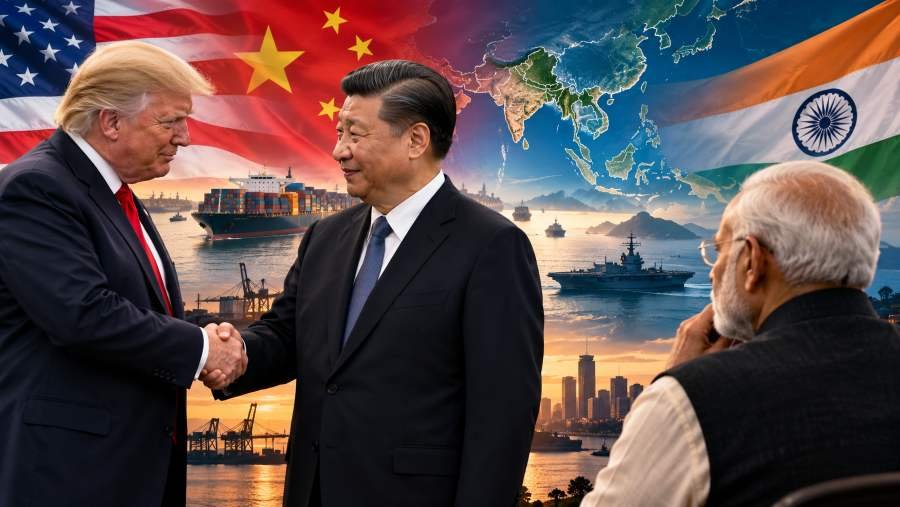
FOR YEARS, Washington and Beijing seemed to be travelling on two trains racing towards a collision. Now, at least temporarily, the brakes have been applied.
Donald Trump’s warm engagement with Chinese President Xi Jinping in Washington marks a noticeable change in the atmosphere between the world’s two largest powers. The old language of confrontation is giving way, at least temporarily, to bargaining, negotiation and calculated accommodation.
For India, this changing landscape carries an important message. New Delhi cannot build its foreign policy on the assumption that America and China will remain permanent adversaries. If Trump moves closer to Xi, even for economic or strategic reasons, India will have to carefully protect its own interests.
The Trump-Xi meeting does not mean that the rivalry between America and China has ended. But it does show that both leaders are prepared to manage their differences when their interests demand it.
Why Trump Chose Pragmatism
Trump’s warm reception for Xi marked a shift from confrontation to pragmatic diplomacy. Prolonged trade tensions have highlighted the limits of relying solely on economic pressure, while China’s control over critical minerals and resilient economy have complicated Washington’s strategy.

Trump also needs stability to address other geopolitical challenges. The warmth was therefore less a retreat than an attempt to create space for negotiations with America’s most powerful economic rival.
Better US-China relations could open Chinese markets to American goods, improve access to critical minerals and expand Chinese purchases of US energy and agricultural products.
Cooperation on fentanyl and artificial intelligence could also serve American interests. The two sides have also established new channels for trade and investment and agreed to continue dialogue on advanced artificial intelligence.
Most importantly, reduced tensions would provide greater economic predictability and allow Washington to concentrate on other global challenges. The real test, however, will be whether diplomatic warmth produces durable and enforceable commitments.
India’s relationship with America has grown partly because both countries are concerned about China’s increasing influence in the Indo-Pacific. Defence cooperation, technology partnerships and coordination with countries such as Japan and Australia have strengthened India’s position.
A warmer relationship between Trump and Xi could change some of these calculations. If Washington becomes more interested in trade and economic stability with Beijing, the pressure on China may reduce.
This does not mean America will abandon India. India remains an important economic and strategic partner. But New Delhi should not assume that Washington’s relationship with Beijing will always remain hostile.
The lesson is simple: India must build its own strength rather than depend on the rivalry between two major powers.
Challenges Before India
The first challenge is economic. If American companies become more comfortable doing business with China, India could face greater competition for investment and manufacturing. India will have to offer better infrastructure, easier business conditions and a more competitive manufacturing environment.

The second challenge is technology. China has made rapid advances in artificial intelligence, electric vehicles, batteries, telecommunications and other strategic areas. India needs to accelerate its own technological development.
The third challenge is security. The India-China border dispute remains unresolved, despite the disengagement and gradual stabilisation of bilateral relations since 2024.
If relations between Washington and Beijing improve, China could acquire greater diplomatic space in Asia. India will therefore have to maintain strong military preparedness.
The fourth challenge is China’s close relationship with Pakistan. Better US-China relations will not necessarily change Beijing’s ties with Islamabad. India must continue to carefully watch developments on both its northern and western fronts.
The fifth challenge is diplomatic. India must remain close to America without becoming dependent on Washington.
Impact on Asia
The Trump-Xi engagement could send ripples across Asia. Japan, South Korea, Australia and Southeast Asian countries will closely watch how far America is prepared to accommodate China.

A reduction in US-China tensions could provide China with greater diplomatic space in the region. Beijing could use the opportunity to strengthen its economic and political influence among smaller Asian countries.
But there is another side. Lower tensions between the two major powers could reduce the danger of a serious conflict in the Indo-Pacific. India has a strong interest in regional stability because its economic growth increasingly depends on trade, investment and secure sea routes.
India should therefore support peace and stability while remaining firm on its security interests.
The Arab World
The changing US-China equation will also affect the Arab world. China has built strong economic relations with Gulf countries, while America continues to have an important security role in the region.
India has vital interests there because of energy supplies, trade, investment and millions of Indians working in the Gulf.
New Delhi should not allow itself to become trapped in the competition between Washington and Beijing in West Asia. It needs balanced relations with America, China, Saudi Arabia, the United Arab Emirates, Iran and other important countries.
India’s growing economic and diplomatic influence in the Arab world gives it an opportunity to pursue an independent policy based on its own interests.
What Should India Do?
India’s policy towards America should be based on cooperation without dependence.
New Delhi should deepen defence and technology cooperation with Washington, while retaining freedom to take independent decisions on Russia, Iran and other international issues.
India should also negotiate firmly on trade and tariffs. A strong economic relationship with America is important, but it must serve Indian interests as well.
At the same time, India should strengthen relations with Japan, Australia, Europe and Southeast Asia. A wider network of partnerships will give New Delhi greater diplomatic room to deal with both Washington and Beijing.
Above all, India must strengthen itself. A larger manufacturing base, stronger defence industry, advanced technology and greater energy security will increase its bargaining power.
What Came Out of the Trump-Xi Meeting?
The Trump-Xi meeting did not end the rivalry between America and China. It produced an effort to manage their differences and prevent another damaging confrontation.
Trade, tariffs, technology, artificial intelligence and critical minerals remained central to their discussions. The two sides extended their trade truce, agreed to continue economic and trade consultations, and established new channels for investment and cooperation.
They also agreed to continue dialogue on artificial intelligence and crisis communication, while China announced measures relating to fentanyl precursor chemicals and commitments to purchase American coal.

The agreements do not remove the fundamental differences between Washington and Beijing. But they demonstrate that the two powers are prepared to negotiate and cooperate in areas where their interests converge.
For India, the meeting should be viewed as a reminder that international relationships are never permanently fixed. Friends can disagree, rivals can negotiate and strategic competitors can cooperate when their interests converge.
The geopolitical chessboard is being rearranged. India must not wait to see where the pieces finally settle.
Its strategy should be to remain engaged with America, manage differences with China, deepen partnerships across Asia and the Arab world, and strengthen its own economic and military capabilities.
India’s safest anchor in this uncertain sea is not America or China, but its own national strength and strategic autonomy.